

Choose peptides supplied with batch certificates of analysis that include orthogonal identity data, HPLC purity alongside HRMS, before anything else. Once that document is in hand, confirm method performance details (LOQ, LOD, repeatability), then check manufacturing origin, documented stability, and lot traceability. Any supplier that cannot produce all four on request is not ready for formulation or research use.
TL;DR:
- Ensure peptides are supplied with batch-specific certificates of analysis including orthogonal identity data, HRMS, and stability testing to verify true identity and purity.
- Confirm the amino acid sequence, INCI, IUPAC, and CAS numbers match across documentation before procurement, and demand purity above 99% supported by two independent analytical methods.
- Match the physical form of the peptide—lyophilised or solution—to your handling timeline and storage conditions, with stability data backed by real time-point studies.
- Implement rigorous supplier due diligence by requesting raw spectral data, verifying lot traceability, and avoiding purchasing from suppliers unwilling to provide full method details or third-party validation.
- For best results, conduct accelerated stability and compatibility tests in your final formulation to establish reliable concentration ranges and ensure downstream process integrity.
Table of Contents
- Key selection criteria checklist for cosmetic peptide actives
- Analytical requirements and interpreting a certificate of analysis
- Stability, handling and storage: lab workflows to preserve peptide integrity
- Formulation compatibility and concentration guidance for cosmetic applications
- Supplier due diligence and how Peptilab maps to best practice
- Common peptide synthesis methods and their impact on purity and activity
- Typical contaminants or impurities in cosmetic peptides and their effects
- Standardized nomenclature and peptide sequence verification best practices
- Quality assurance programs and certifications beyond COAs
- Risk management for adulteration and falsification in peptide sourcing
- Practical perspective: balancing purity, cost and scalability in peptide sourcing
- Get research-grade peptides with documentation you can verify
- FAQ
- Sources
Key selection criteria checklist for cosmetic peptide actives
A peptide active earns a place in your formulation pipeline only after it clears a short list of checks that go beyond a percentage on a label. Chemical identity comes first: confirm the INCI name, the IUPAC designation, the CAS number, and the actual amino acid sequence against the certificate. A mismatch here invalidates everything that follows.
Purity numbers need context. Chromatographic purity from a single HPLC run tells you how clean the main peak looks, not whether that peak is actually the peptide you ordered. True identity confirmation requires a second, orthogonal method, which we cover in the next section. Physical form matters for workflow: lyophilised peptide suits long-term storage and bulk formulation planning, while pre-dissolved solutions suit faster bench work but carry a shorter practical shelf life once reconstituted.
Batch consistency and lot traceability separate a research-grade supplier from a repackager. Every batch should carry its own COA, its own lot number, and a stated expiry tied to actual stability data rather than a generic shelf-life assumption. Reject any claim of stability that is not backed by a time-point study.
Acceptance thresholds should reflect intended use. A screening lot destined for early bench comparisons can tolerate more flexibility than a lot headed into a final formulation that will eventually require Cosmetic Notification Form documentation.
- Confirm INCI, IUPAC, CAS, and sequence match the COA before ordering.
- Require purity above 99% supported by two independent analytical methods.
- Match physical form (lyophilised or solution) to your actual handling timeline.
- Insist on lot-specific expiry dates tied to real stability data, not estimates.
Pro Tip: Keep a running log of COA data by lot number so a supplier’s analytical consistency across batches becomes visible over time, not just within one order.
Analytical requirements and interpreting a certificate of analysis
An HPLC chromatogram shows you retention time and relative peak area, which is useful for estimating purity but blind to a peptide’s actual mass or sequence. A truncated or deamidated variant can co-elute with the intended product and still post a clean HPLC purity figure. That is why high-resolution mass spectrometry, ideally with MS-MS fragmentation, matters: it confirms molecular identity and can expose low-level truncations or modifications that a single chromatographic method will miss.
A valid certificate of analysis should state method performance figures, limit of quantitation, limit of detection, analytical range, and repeatability (expressed as coefficient of variation), so an independent lab can judge whether the reported purity is reproducible and fit for purpose. Without those figures, a purity claim is effectively unverifiable.
Treat the distinction between manufacturer-generated data and third-party testing as material, not cosmetic. A COA produced entirely in-house, with no outside verification, carries more risk of undisclosed bias, even when the chemistry is sound. Red flags include a COA that reports only a purity percentage with no method file, no retention time, and no mass spectrum attached.
- Request the full chromatogram, not just the summary purity percentage.
- Ask for HRMS data showing the expected mass and any fragmentation pattern.
- Confirm LOQ, LOD, range, and CV are stated, not just referenced.
- Treat a refusal to share raw spectra or method files as grounds to pause the order.
If a supplier withholds method files, escalate the request in writing, and if the refusal continues, treat the lot as unverified regardless of the purity number printed on the label.
Stability, handling and storage: lab workflows to preserve peptide integrity
Lyophilised peptide generally tolerates ambient shipping over short durations but should move to freezer storage on arrival. Reconstituted solutions degrade faster and need refrigeration, with use windows measured in days to weeks depending on the sequence and buffer. Degradation most commonly shows up as oxidation at methionine or cysteine residues, deamidation at asparagine or glutamine, or truncation from incomplete synthesis that was missed at release testing.
- Store lyophilised peptide at minus 20 degrees Celsius or lower until first use, protected from light and moisture.
- Reconstitute using the solvent and pH specified by the supplier, under sterile technique, to limit microbial and chemical degradation.
- Keep reconstituted aliquots refrigerated and discard unused solution after the supplier’s stated use window.
- Ask for accelerated stability data (elevated temperature over fixed time points) rather than accepting a flat shelf-life claim with no supporting study.
- Confirm packaging and any excipients (buffers, cryoprotectants) are disclosed, since they affect both stability and downstream formulation compatibility.
Conjugation strategies such as PEGylation can meaningfully extend thermal stability in solution, which is one reason some actives ship as modified forms rather than the native peptide, as documented research on N-terminal PEGylation has shown. For a fuller stepwise protocol, our stability testing workflow walks through accelerated ageing in more detail.
Formulation compatibility and concentration guidance for cosmetic applications
Starting concentration should come from your own bench data, not a marketing claim borrowed from a competing product. Most cosmetic peptides begin screening in the low parts-per-million to low percentage range depending on the sequence and intended claim, with the final figure justified through dose-response testing rather than assumed from a supplier’s suggestion. Our concentration guidelines for skincare researchers walk through how to structure that experimental design.
Vehicle choice, pH, and excipient interactions can make or break an otherwise sound peptide. Many sequences are pH-sensitive and degrade outside a narrow range, so compatibility testing with your specific preservative system and emulsion base is not optional. Accelerated ageing studies, run alongside preservative efficacy testing, reveal interactions that a bench stability check alone will miss.
- Run dose-response screening before fixing a concentration for a finished formulation.
- Test peptide stability in the actual vehicle and pH range of the final product, not in buffer alone.
- Document preservative interaction results, since some systems degrade peptide actives over time.
- Keep compatibility data on file for Cosmetic Notification Form submission and internal quality control review.
Pro Tip: Run your accelerated stability and preservative interaction tests in parallel rather than sequentially, since a formulation that fails one often fails both for related chemical reasons.
Any claim that will appear on packaging should trace back to the documented concentration and stability data, since an unsupported claim creates regulatory exposure well before it creates a marketing problem. Our efficacy testing methods guide covers assay design for substantiating those claims.
Supplier due diligence and how Peptilab maps to best practice
A procurement checklist should include, at minimum, a COA with full method details, HRMS spectra, MS-MS fragmentation where relevant, a stability report, an MSDS or WHMIS sheet, and lot traceability. Confirm manufacturing origin and fulfillment location directly, since cross-border shipping introduces import delays and added regulatory ambiguity that domestic sourcing avoids.
- Request a sample order before committing to bulk volume.
- Verify every figure on the COA against the raw data, not just the summary page.
- Run your own confirmatory test on the first lot before scaling future orders.
- Treat verified third-party testing as a stronger signal than a supplier’s own internal claims.
Our sourcing guide for cosmetic-grade peptides walks through what that documentation looks like in practice.
Common peptide synthesis methods and their impact on purity and activity
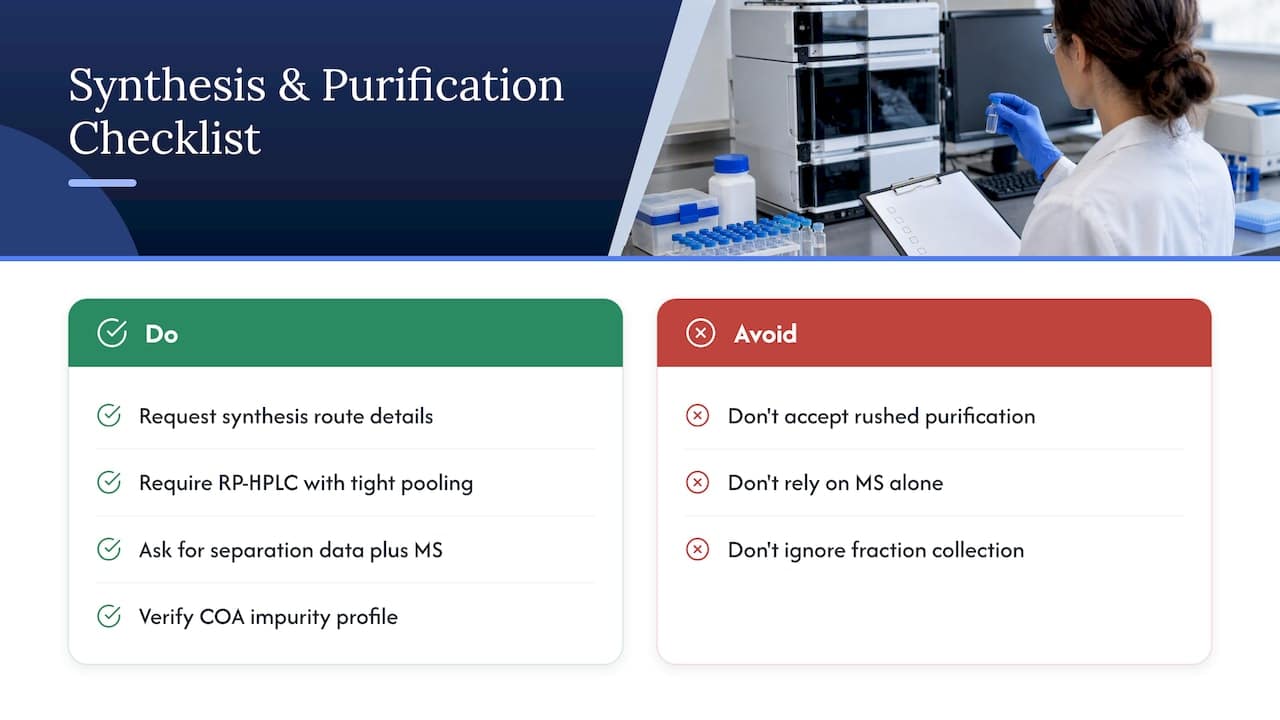
Most cosmetic and research peptides are produced through solid-phase peptide synthesis, where amino acids are added sequentially to a resin-bound chain. Longer sequences and those with difficult secondary structures accumulate more side reactions during this process, which lowers the yield of the correctly formed product and increases the burden on downstream purification.
Incomplete coupling steps leave truncated fragments in the crude mixture. Side-chain protecting groups that are not fully removed during cleavage leave modified byproducts that can closely resemble the target peptide in chromatographic behaviour. Racemization at sensitive residues during synthesis can also generate a diastereomer that shares the same mass as the intended peptide, which is one reason mass spectrometry alone, without complementary separation data, is not sufficient for identity confirmation.
Purification method matters as much as synthesis method. Reverse-phase HPLC purification removes the bulk of truncated and modified species, but the stringency of that purification, how many fractions are collected and how tightly they are pooled, directly affects the final purity ceiling. A synthesis route that is otherwise sound can still deliver a mediocre final product if purification is rushed to cut cost. Formulators sourcing an active for a finished cosmetic should ask which synthesis and purification approach a supplier uses, since that detail predicts the kind of impurity profile you are likely to see on the COA.
Typical contaminants or impurities in cosmetic peptides and their effects
Truncated sequences, missing one or more residues from incomplete coupling, are the most common impurity class and typically carry reduced or absent biological activity, diluting the effective potency of a batch without necessarily showing up on a basic purity scan. Deamidated variants, where asparagine or glutamine residues convert to aspartate or glutamate, alter the peptide’s charge and can change how it interacts with its intended target in a formulation.
Oxidized residues, particularly at methionine, cysteine, or tryptophan, commonly form during storage or exposure to air and light, and can reduce stability further once oxidation begins. Racemized residues and diastereomers are harder to detect since they share the parent peptide’s mass, which is why chiral separation or specialized analytical techniques are sometimes needed for sequences known to be synthesis-sensitive.
Residual synthesis reagents, such as coupling agents or scavengers from the cleavage step, represent a separate contamination class entirely unrelated to the peptide’s own structure. These residues are a cosmetic safety consideration independent of peptide purity and should be addressed through the supplier’s own impurity testing rather than assumed away by a high HPLC purity number. Any of these impurity classes can affect both the stability and the sensory properties of the finished cosmetic formulation, which is why a single purity percentage, taken alone, understates the quality picture a formulator actually needs.
Standardized nomenclature and peptide sequence verification best practices
Consistent naming prevents costly sourcing errors. The INCI name is the regulatory identifier used on cosmetic labels, the IUPAC name describes the chemical structure precisely, and the CAS number ties the substance to a unique registry entry. A formulator comparing quotes from multiple suppliers should confirm all three align on every document before treating two quotes as referring to the same active.
Sequence verification is the step that actually confirms you are buying the peptide you think you are buying. The amino acid sequence, written in standard one-letter or three-letter code, should match across the COA, the technical data sheet, and any safety documentation. A single-residue substitution can change a peptide’s activity profile substantially while leaving the overall molecular weight nearly identical, so sequence confirmation through mass spectrometry fragmentation data, not molecular weight alone, is the more reliable check.
Where a peptide carries a non-standard modification, acetylation, amidation, or a fatty acid conjugate, that modification should be explicitly named in both the INCI entry and the technical documentation. Ambiguity here tends to surface later, during Cosmetic Notification Form preparation, when the ingredient listing needs to match exactly what was tested and what is actually in the formulation.
Quality assurance programs and certifications beyond COAs
A certificate of analysis documents a single batch. It says nothing about whether the facility that produced that batch operates under a consistent quality system across every batch it makes. ISO 22716 sets out good manufacturing practice guidelines for the production, control, storage, and shipment of cosmetic products, and is the commonly referenced quality framework cosmetic manufacturers point to when demonstrating facility-level discipline.
That standard applies most directly to commercial-scale manufacturing rather than early research and development work, but research labs preparing material that may eventually scale toward a finished cosmetic benefit from adopting GMP-aligned practices well before that transition becomes mandatory. Retrofitting a quality system after a formulation is already headed toward commercial notification is far more disruptive than building toward it from the start.
Beyond ISO 22716, look for evidence of documented internal quality procedures: change control when a supplier alters a synthesis route, deviation reporting when a batch falls outside specification, and a defined process for recalling or quarantining a lot that fails release testing after shipment. A supplier who can describe these processes concretely, rather than gesturing at “quality control” as a general claim, is demonstrating the kind of operational maturity a COA alone cannot show.
Risk management for adulteration and falsification in peptide sourcing
Peptide adulteration takes several forms: a batch cut with an inactive filler to stretch yield, a mislabelled sequence substituted for a more expensive one, or a COA copied from a previous batch and reissued without new testing. Each of these risks is reduced by the same practice, independent confirmatory testing on every new lot rather than trusting a supplier’s paperwork at face value.
Request the raw analytical files, not just the summary report, and compare retention times and mass spectra across multiple batches from the same supplier. A COA that is suspiciously identical to a previous batch’s document, down to the retention time and peak area, is a signal worth investigating before the order ships, not after.
Lot traceability closes the loop. A supplier who can trace a specific shipment back to a specific synthesis run and a specific analytical test is far less likely to be substituting material undetected than one who issues generic certificates disconnected from individual shipments. Build confirmatory testing into your receiving process as standard procedure, not as an exception reserved for suppliers you already distrust, since the cost of a single undetected substitution in a formulation that reaches later-stage testing or notification is far higher than the cost of routine verification.
Practical perspective: balancing purity, cost and scalability in peptide sourcing
Early R&D work rewards spending on identity confirmation and reproducible analytics over spending on volume. A screening lot with a slightly higher cost but a complete orthogonal data set saves far more time than a cheaper lot that fails confirmatory testing after you have already built a study around it. Save the cost-driven compromises for later, once a sequence has proven itself and only batch-to-batch consistency, not identity, is in question.
— Admin
Get research-grade peptides with documentation you can verify
We supply research and cosmetic peptide actives with batch-specific certificates of analysis, third-party verified purity above 99%, and full manufacturing transparency, built from a supply chain that avoids the import delays cross-border sourcing often creates.

- Browse current research and cosmetic peptide listings and request a COA before ordering.
- Order a sample lot first, verify the documentation, then scale to a bulk order with confidence.
- Review our supplier sourcing guide for a fuller breakdown of what to request from any active ingredient supplier.
FAQ
What purity level should I require for a cosmetic peptide active?
A supplier offering this level of verification, backed by batch-specific certificates of analysis, meets the standard most formulation and research work demands.
Why isn’t HPLC purity alone enough to confirm peptide identity?
HPLC measures relative peak area and retention time, which can mask a truncated or modified variant that co-elutes with the intended peptide. High-resolution mass spectrometry, ideally with fragmentation data, confirms the actual molecular identity that HPLC cannot verify on its own.
Does a cosmetic peptide need to be listed on Health Canada’s Cosmetic Notification Form?
Manufacturers and importers must notify Health Canada within 10 days of a cosmetic’s first sale by submitting a Cosmetic Notification Form listing ingredients and concentrations. Our CNF and Hotlist guide walks through the timing and documentation involved.
Does absence from the Cosmetic Ingredient Hotlist mean an ingredient is safe?
No. Health Canada maintains the Cosmetic Ingredient Hotlist of prohibited and restricted ingredients, but absence from that list is not an endorsement of safety. Manufacturers still carry the responsibility to perform their own safety verification.
What documentation should a peptide supplier provide beyond a basic purity percentage?
A complete package includes a certificate of analysis with method performance figures, HRMS spectra, a stability report, and lot traceability tied to that specific shipment. This documentation is provided with every batch supplied, verified through third-party testing.
Sources
A supplier’s reputation is only as strong as the documentation backing it. Verified customer reviews and a track record of consistent batch-to-batch COA data carry more weight than marketing copy, since they reflect what actually arrives in a shipment rather than what a product page promises.
Where possible, ask for references from other laboratories or formulation teams who have ordered from the same supplier, particularly ones working on a comparable application. A supplier willing to connect you with an existing customer, or to share an audit summary from a facility inspection, is signalling confidence that a supplier unwilling to do either typically lacks.
Third-party testing credentials matter more than self-reported claims. A supplier that routes every batch through an independent laboratory for purity and identity confirmation, rather than relying solely on in-house analysis, is giving you a built-in check against undisclosed error or bias. Ask directly which laboratory performs that testing and whether the resulting data is available on request, not just summarized.
Treat a pattern across multiple orders as more informative than any single transaction. A supplier whose COA format, method performance figures, and turnaround time stay consistent across several lots has demonstrated the kind of operational discipline that a single clean certificate cannot prove on its own.
- Canada
- ISO 22716:2007 – Cosmetics — Good Manufacturing Practices
- Stability‑enhancing N‑terminal PEGylation of peptides — ACS publication