

A cosmetic peptide goes on a Canadian label under its INCI name, not under the trade name on the supplier’s data sheet. Argireline becomes Acetyl Hexapeptide-8, GHK Copper Peptide becomes Copper Tripeptide-1, and Matrixyl is generally written as Palmitoyl Pentapeptide-4. This guide gives you the common mappings, explains where Canadian rules apply, and shows how to keep your records straight from bench to label.
TL;DR
- INCI is the name Canada requires on cosmetic labels and in notifications. Health Canada’s labelling guide defines it as the name assigned in the International Cosmetic Ingredient Dictionary and Handbook.
- Trade names (Argireline, Matrixyl) and research shorthand (GHK Copper Peptide) are not label names. Map each material to its dictionary entry.
- Peptide INCI names follow a pattern: optional modifier (Acetyl, Palmitoyl, Copper), then the chain length (Tri-, Tetra-, Penta-, Hexa-), then a number.
- A name in a database does not make a formula compliant. Claims, concentration and the Hotlist all still apply.
- Keep sequence, salt form, purity and COA data in your technical file even though the label shows only the INCI name.
Table of Contents
- What an INCI name is, and why peptides need extra care
- How peptide INCI names are built
- Common cosmetic peptides and their INCI names
- What Canadian rules say about the name you print
- A name does not decide whether a product is a cosmetic
- A workflow for building your peptide INCI table
- Common mistakes we see
- Our perspective: treat the name as part of the material
- Where to source documented peptides in Canada
- FAQ
- Sources
What an INCI name is, and why peptides need extra care
INCI stands for International Nomenclature of Cosmetic Ingredients. Health Canada’s labelling guide describes it as one internationally recognized name that replaces the many trade and technical names an ingredient may carry, and the system is multilingual and Latin-based so the same ingredient reads the same everywhere (Health Canada).
Peptides are a special headache because one molecule collects several identities:
- a research name (often the amino acid sequence, such as GHK),
- a trade name chosen by the raw-material maker,
- a marketing name used on consumer packaging,
- and the INCI name, the only one that belongs on the label.
The INCI dictionary lists each INCI name alongside empirical formulas, trade names and CAS numbers, which is what lets you identify a material without guessing (Health Canada). That is the habit to build: start from the exact material you are holding, then find its entry. Do not start from the name the brochure uses.
How peptide INCI names are built
Most cosmetic peptide names are assembled from three parts.
- Modifier. Many peptides are chemically modified to improve stability or skin affinity. Acetyl and Palmitoyl are the two you will meet most often. Copper indicates a metal complex.
- Chain length. Dipeptide, Tripeptide, Tetrapeptide, Pentapeptide, Hexapeptide and so on, counting amino acids.
- Number. A sequential identifier that separates different sequences of the same length. Palmitoyl Tripeptide-1 and Palmitoyl Tripeptide-5 are different molecules.
The number carries no ranking and no meaning about strength. It simply separates one registered sequence from another. This is why swapping “Tripeptide-1” for “Tripeptide-3” in a spreadsheet is a real error, not a typo.
Common cosmetic peptides and their INCI names
The table below covers names that appear most often on supplier sheets and ingredient lists. Treat it as a lookup aid, not a replacement for checking the current dictionary entry for your exact material.
| Common or trade name | INCI name to look up | Typical cosmetic role |
|---|---|---|
| Argireline | Acetyl Hexapeptide-8 | Skin conditioning, expression-line products |
| GHK Copper Peptide, copper peptide | Copper Tripeptide-1 | Skin conditioning |
| Pal-GHK | Palmitoyl Tripeptide-1 | Signal peptide in anti-ageing products |
| Matrixyl | Palmitoyl Pentapeptide-4 | Signal peptide in anti-ageing products |
| Matrixyl 3000 (blend) | Palmitoyl Tripeptide-1 and Palmitoyl Tetrapeptide-7 | Listed as separate ingredients |
| Eyeseryl | Acetyl Tetrapeptide-5 | Eye-area products |
| AHK-Cu | Copper Tripeptide-3 (verify entry) | Skin conditioning |
A few notes on the entries.
Acetyl Hexapeptide-8. This is the current name for the ingredient sold as Argireline. Older material and some websites still say Acetyl Hexapeptide-3, which is a reason to confirm the entry against the current dictionary. Databases such as SpecialChem’s INCI entry record the CAS number 616204-22-9 alongside the name, which is the kind of cross-check you want in your file.
Copper Tripeptide-1. GHK Copper Peptide is shorthand for the copper complex of glycyl-histidyl-lysine. On a label it is Copper Tripeptide-1. Do not write GHK Copper Peptide in a notification entry.
Acetyl Tetrapeptide-5. Health Canada’s own NHPID record lists it as an approved chemical name and a topical skin-conditioning non-medicinal ingredient. The NHPID’s June 2025 update also added Palmitoyl Dipeptide-7.
Blends. A branded blend is not one ingredient. Health Canada’s notification guide is clear that a supplier COA, SDS or attached ingredient list does not replace entering each ingredient in the form, so a proprietary blend must be broken into its individual components. Ask the supplier for the full composition before you start.
For a longer list organised by purpose, see our anti-ageing peptide ingredients label guide.
What Canadian rules say about the name you print
Labels
Cosmetic labels in Canada must show the ingredient list, and the INCI name is the standard for it (Health Canada). Spelling, hyphens and spaces matter. “Palmitoyl tri-peptide 1” is not “Palmitoyl Tripeptide-1”, and a reviewer or an automated check will treat it that way.
Cosmetic Notification Form
The notification guide asks for one ingredient per line, entered by INCI name and validated in Health Canada’s search field, with the exact concentration or the applicable concentration-range code (Health Canada).
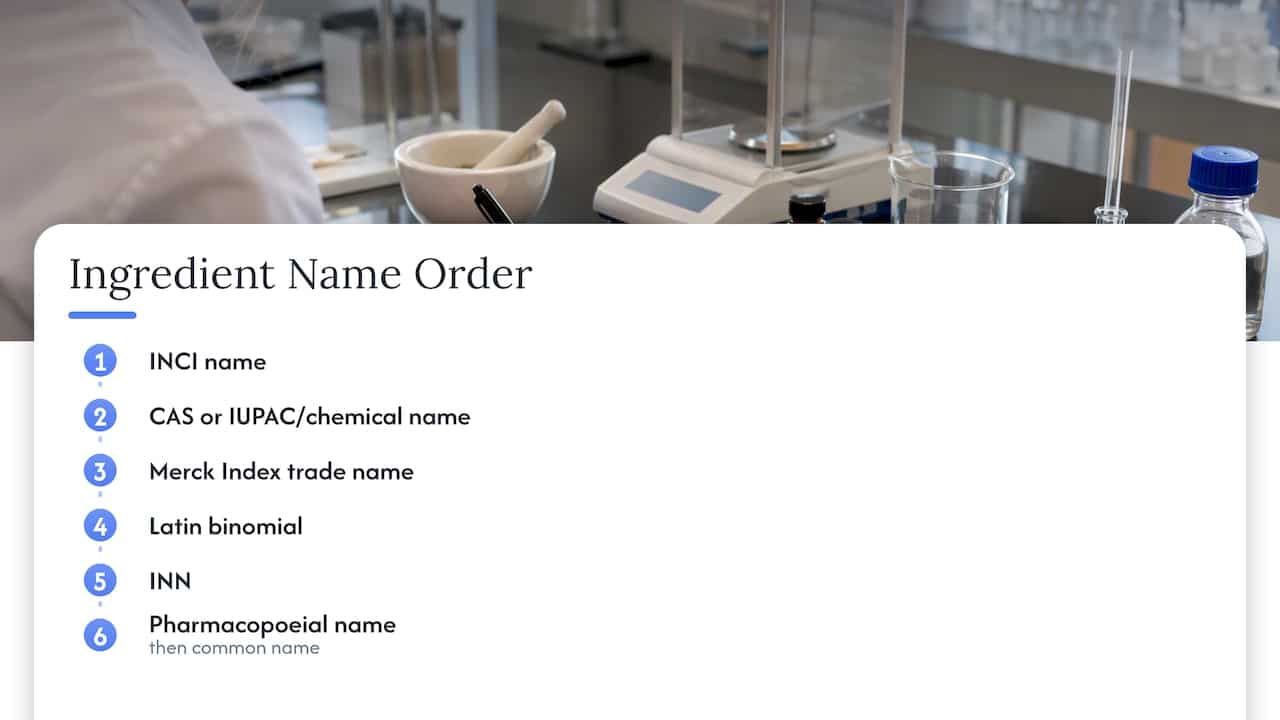
When no INCI name exists, the guide sets a fallback order: INCI name first, then CAS or IUPAC/chemical name, Merck Index trade name, Latin binomial, INN, pharmacopoeial name, and finally common name. It also warns that submitting a non-INCI name can delay processing. A novel or custom peptide often lands in this fallback, so have the CAS number and full chemical name ready.
Our pages on matching CNFs to labels and the 10-day notification timeline for white-label skincare go deeper on the process.
The Hotlist
After you have the name, check it against the Cosmetic Ingredient Hotlist. Health Canada notes that discrepancies between nomenclature exist and that one substance may have several synonyms, so search more than one name. Absence from the Hotlist is not an approval: the guide states the Hotlist is not exhaustive, and the manufacturer or importer remains responsible for complying with the Food and Drugs Act and the Cosmetic Regulations (Health Canada). See also our summary of Hotlist and 10-day CNF rules.
A name does not decide whether a product is a cosmetic
Putting a correct INCI name on a serum does not settle its regulatory category. Health Canada classifies products at the cosmetic-drug interface case by case, and intended purpose and representations weigh heavily (Health Canada guidance). Claims about treating or preventing disease, or restoring or modifying an organic function, can move a product toward drug or natural health product regulation.
Practically, this means reviewing marketing copy at the same time as the ingredient list. A peptide serum labelled with perfectly formatted INCI names can still be classified differently because of its claims, imagery or directions. If your product sits near that line, speak with Health Canada’s cosmetic program or a regulatory consultant before launch.
A workflow for building your peptide INCI table
This is the process we recommend for any formulation file.
- Record the exact material. Note the supplier’s product code, sequence, salt form (acetate, for example), any conjugation such as palmitoylation, CAS number and the batch COA.
- Find the current dictionary entry. Match identity, not marketing name. Use CAS number as the tiebreaker when two names look close.
- Search the name in Health Canada’s notification field. If it returns “not found”, go to the fallback hierarchy and prepare the chemical name and CAS.
- Check the Hotlist under the INCI name and under likely synonyms.
- Confirm concentration. Enter the exact figure or the proper range code. Our concentration guidelines for skincare researchers explain how to document it.
- Break blends into components and repeat steps 1 to 4 for each.
- Compare the final label to the notification line by line, then review claims on the carton, website and advertising.
The point of keeping research-level detail is that INCI is a translation layer, not a quality statement. It tells a regulator what the ingredient is. It does not tell them purity, grade or efficacy, so preserve sequence, salt form, conjugation and analytical identity in your technical records.
Common mistakes we see
- Using the trade name on the label. Argireline and Matrixyl are brand names.
- Copying INCI names from a retail website. Consumer sites often lag behind dictionary updates or use older names.
- Treating a database hit as compliance. An ingredient database confirms the name exists. It says nothing about your concentration, claims or finished formula.
- Listing a blend as one line. Each component needs its own entry.
- Confusing similar numbers. Tripeptide-1, -2 and -5 are separate materials.
- Ignoring the salt or conjugate in the record. Two materials with similar names may differ in form, and your supplier documents should show that.
If you are comparing suppliers, our guide to supplier verification lists what to check on a COA, and the page on sourcing cosmetic-grade peptides covers documentation you should request. For how names carry over into research records, read how peptide ingredient labelling works for researchers.
Our perspective: treat the name as part of the material
We supply peptides to laboratories and formulators, and the problems we hear about rarely start in the lab. They start in the paperwork. A developer orders a material under a research name, the supplier sheet uses a trade name, and the notification form wants a third. By the time someone notices the mismatch, a label proof is already approved.

Our view is simple. The INCI name should be settled when you choose the material, not when you print the carton. That is why we build our catalogue around batch-specific certificates of analysis from third-party testing, so the identity of what you hold can be tied to a document. It is also why we treat lab-grade and cosmetic-grade peptides as separate categories: they are made and documented for different purposes, and our products are intended for scientific, cosmetic and laboratory use, not for personal use or medical purposes.
A name on a label is a promise of identity. Keep the evidence behind it in your file.
— Admin
Where to source documented peptides in Canada
If you are formulating or running cosmetic research, our cosmetic and research peptide catalogue is Canadian-made and fulfilled from within Canada, with third-party tested batches and COAs available. Lab essentials such as syringes, alcohol wipes and bacteriostatic water are in our supplies section. Our products are for professional research, laboratory and formulation use.
FAQ
What is the INCI name for GHK Copper Peptide?
On a cosmetic ingredient list, GHK Copper Peptide is written as Copper Tripeptide-1. GHK Copper Peptide is shorthand used in research and marketing. Confirm the entry in the current dictionary and cross-check the CAS number with your supplier’s documents before you print it.
Do I have to use INCI names on a Canadian cosmetic label?
Yes. Canadian cosmetic regulations define the INCI name as the name assigned in the International Cosmetic Ingredient Dictionary and Handbook, and Health Canada’s labelling guide directs manufacturers to use it. Where no INCI name exists, the notification guide gives a fallback order starting with the CAS or chemical name.
Is a peptide safe to use if it is not on the Hotlist?
Not automatically. Health Canada states that the Hotlist is not exhaustive, and responsibility for compliance stays with the manufacturer or importer. Check the Hotlist, the concentration, and the finished formula at every notification.
Does a peptide serum count as a cosmetic in Canada?
It depends on the product’s representation, intended purpose, composition and format, not on the word “peptide”. Health Canada’s classification guidance says claims about treating disease or modifying body function can shift a product into drug or natural health product rules.
How do I list a peptide blend?
List each component separately by its own INCI name, one per line in the notification form. Ask the blend supplier for the full composition, because a COA or SDS alone does not replace the entries.
Sources
- Industry Guide for the labelling of cosmetics, Health Canada
- Notification of Cosmetics: Guide for Cosmetic Notifications, Health Canada
- Cosmetic Ingredient Hotlist, Health Canada
- Cosmetic advertising, labelling and ingredients, Health Canada
- Guidance Document: Classification of Products at the Cosmetic-Drug Interface, Health Canada
- NHPID record: Acetyl Tetrapeptide-5, Health Canada
- NHPID update, 27 June 2025, Health Canada
- Acetyl Hexapeptide-8 INCI entry, SpecialChem