
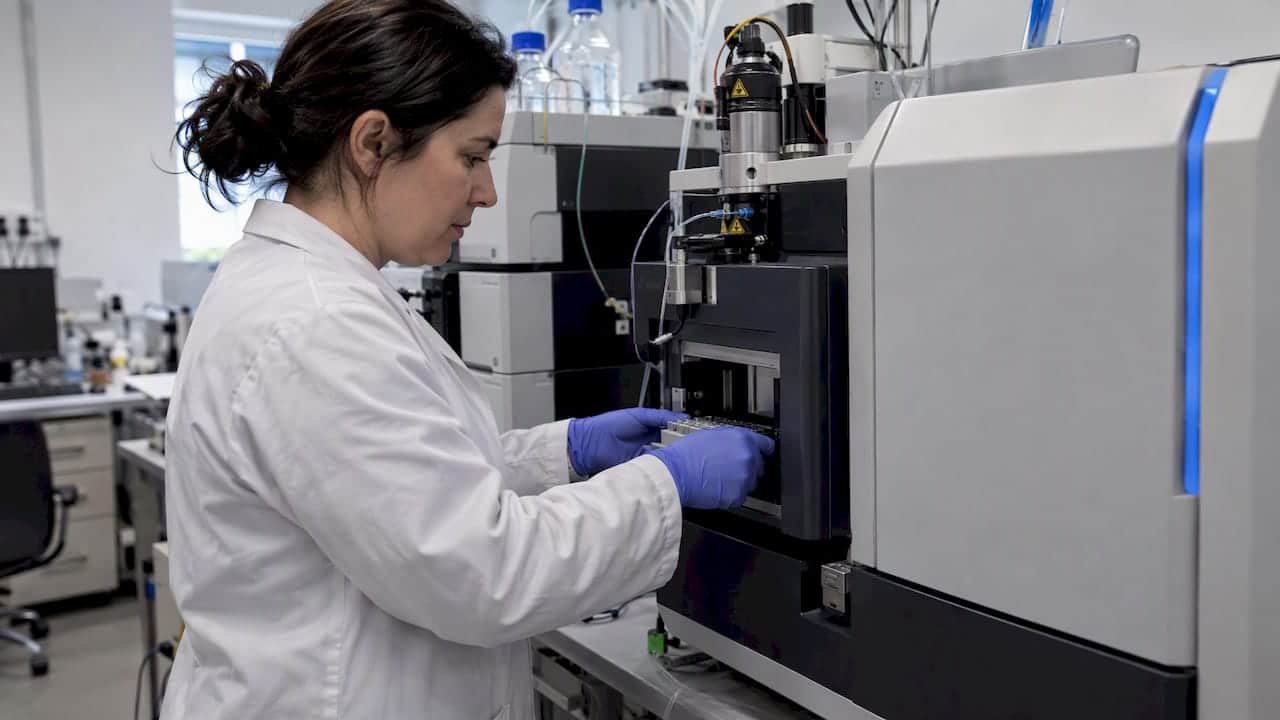
Counterfeit or misrepresented research-grade peptide reagents exist, and they threaten the reproducibility of every experiment built on them. The immediate action when you suspect a problem is simple: require a lot-specific certificate of analysis (COA) and pause use of the material until you arrange orthogonal verification, ideally HPLC paired with LC-MS/MS. Reference methods from the National Research Council and peptide suppliers that publish batch COAs and ship domestically give you a practical starting point for building that verification habit.
TL;DR:
- HPLC can miss co-eluting impurities, so pair it with LC-MS/MS to confirm mass and sequence; use NMR or QNMR when structure or nonpeptide residuals need verification.
- When sample volume restricts options, prioritize LC-MS/MS as the most informative assay, but treat one-platform analysis as a compromise, not a substitute for orthogonal testing.
- Match each vial’s lot number to a method-specific certificate of analysis, check solubility and retention time against a known standard, and quarantine mismatches before study use.
- Treat a missing certificate, an unstated assay method, or an unreachable supplier as a warning; none alone proves counterfeiting, but each warrants verification.
- Require accredited ISO/IEC 17025 independent testing for lots used in regulatory submissions or published studies, and retain certificates and aliquots for later retesting.
Table of Contents
- Which analytical methods actually detect counterfeit or misrepresented peptides?
- What vendor documentation and supplier checks should you require?
- How should a lab verify a peptide shipment on receipt?
- What reference materials and standards support verification?
- How do procurement controls reduce counterfeit risk?
- What happens when counterfeit peptides reach research or cosmetic applications?
- What do documented counterfeit incidents show about detection?
- What regulatory and legal frameworks apply to peptide authenticity in Canada?
- Why supplier transparency on COAs and fulfillment matters
- How Peptilab fits the verification checklist you just read
- FAQ
- Sources
Which analytical methods actually detect counterfeit or misrepresented peptides?
No single test tells you everything about a peptide’s identity and purity. HPLC separates a sample into its component peaks and gives you a purity profile, but it can miss co-eluting impurities that share a retention time with your target peptide. A peak that looks clean on HPLC alone can still hide a structurally similar contaminant.
LC-MS/MS closes that gap. Coupling liquid chromatography to tandem mass spectrometry lets you confirm molecular identity by mass and, through fragmentation patterns, verify amino acid sequence. The Proteomics and Mass Spectrometry Laboratory at the NRC uses HPLC directly coupled with high-accuracy tandem mass spectrometers to identify peptides in complex mixtures and flag impurities that single-method testing would miss. When a vendor’s claimed mass doesn’t match what LC-MS/MS returns, that is a direct signal of substitution or degradation.
NMR, and quantitative NMR (QNMR) in particular, becomes necessary when you need structural confirmation beyond mass and sequence, or when you need to quantify non-peptide residuals such as counter-ions and bound solvents that mass spectrometry alone won’t resolve cleanly.
- HPLC reveals purity profiles and detects gross impurities but can miss co-eluting species.
- LC-MS/MS confirms molecular identity and exposes incorrect mass or sequence fragments.
- NMR/QNMR confirms structure and quantifies residuals that other methods underestimate.
A CCQM inter-laboratory comparison coordinated by BIPM found that mass-balance approaches produced smaller measurement uncertainties for peptide purity assignment than single-method PICAA approaches. That finding is the practical argument for orthogonal testing: combining methods narrows your uncertainty, while trusting one assay leaves blind spots exactly where counterfeiters exploit them. Sample volume and detection limits still matter: a lot too small to split across three analytical platforms may force you to prioritize LC-MS/MS as the single most informative test, but that is a compromise, not a substitute for the full workflow when the material matters.
What vendor documentation and supplier checks should you require?
A credible peptide supplier gives you more than a one-page purity statement. Before accepting a lot into any study, your checklist should confirm the documentation actually supports the claims printed on it.
- A lot-specific COA naming the analytical method used, quantified residuals (water, counter-ions, trifluoroacetic acid), and a traceable lot number tied to that exact vial.
- Contactable technical staff at the supplier who can answer questions about the method and instrumentation behind the COA.
- Preference for third-party ISO/IEC 17025 accredited results, or mass-balance and QNMR-backed purity claims, over a vendor’s in-house-only assertion.
- Documented chain of custody from manufacture through shipping, so you can trace a lot back if a later experiment raises questions.
Operational red flags include a missing COA, a purity claim with no stated method, and purchase channels that offer no way to contact a real lab or verify a business address. None of these alone proves a product is counterfeit, but together they describe exactly the kind of anonymous supply chain where substitution goes undetected. Our supplier verification guide walks through the same checklist in more depth.
Keep every COA, chain-of-custody note, and a retained aliquot of each lot on file. That record is what lets you re-test months later if a result doesn’t replicate.
Pro Tip: File COAs by lot number, not by product name, so you can pull the exact document for the exact vial a reviewer asks about.
How should a lab verify a peptide shipment on receipt?
A workflow that starts the moment a box arrives catches most problems before they reach a bench.
- Check paperwork first. Confirm the lot number on the vial matches the COA, and that the COA states a method, not just a number.
- Run quick in-house checks. Visual inspection, solubility behaviour, and a spot-HPLC retention-time comparison against a known standard catch obvious substitutions fast.
- Escalate to LC-MS/MS when retention time looks off, when the lot is destined for a high-impact experiment, or when the supplier is new to your approved list. Interpret a mass-fragment mismatch as grounds for quarantine, not a result to work around.
- Apply mass-balance accounting for an accurate purity assignment rather than relying on a single chromatographic peak area, and request NMR or QNMR when non-peptide residuals need quantifying.
- Set a decision gate: accept, quarantine for further testing, or reject, with each threshold documented before testing begins rather than decided case by case.
- Quarantine procedures should hold a lot out of active studies until orthogonal results come back.
- Accredited third-party testing becomes mandatory, not optional, for any lot feeding a regulatory submission or a publication-bound dataset.
Our guide to analytical techniques breaks down instrument selection in more detail for labs building this workflow from scratch.
What reference materials and standards support verification?
Certified reference materials (CRMs) give you a fixed point to calibrate against, rather than trusting a vendor’s claim or your own uncalibrated instrument. ANGII-1, the NRC’s certified reference material for angiotensin II, carries certified mass-fraction values along with information values for water and trifluoroacetic acid content, making it suitable for calibrating mass-balance approaches and validating in-house methods.
Chemical fingerprinting extends this further. NRC research on natural product and food authentication uses chemical fingerprinting and DNA barcoding to build reference libraries that flag adulteration, an approach adaptable to peptide authentication where a sample’s chemical signature can be checked against a known library.
- Use a CRM when you need certified, traceable values for calibration or method validation.
- Use an in-house standard for routine batch-to-batch comparison once your method is validated against a CRM.
- Expect lower measurement uncertainty when a CRM anchors your mass-balance calculations instead of an uncalibrated reference.
How do procurement controls reduce counterfeit risk?
Verification at the bench only works if procurement feeds it defensible lots in the first place.
- Maintain a vetted supplier list and require COA-backed approval before any bulk purchase proceeds.
- Quarantine incoming lots pending verification and retain sample aliquots for later re-testing if a result is ever questioned.
- Favour traceable payment and shipping channels, and avoid anonymous marketplaces for research reagents where no return address or business registration exists.
- Treat ISO/IEC 17025 third-party testing as mandatory when a lot feeds a regulatory submission or a high-impact experiment, not as an optional extra.
Our quality control guide for bulk orders and batch consistency guide both expand on building these controls into a standing procurement policy rather than a one-off check.
Pro Tip: Score each supplier against your checklist once, keep the scorecard on file, and only re-score when something changes, not on every reorder.
What happens when counterfeit peptides reach research or cosmetic applications?
A substituted or underdosed peptide doesn’t announce itself. It produces a result that looks like a failed experiment, a formulation that underperforms, or worse, a result that looks real but isn’t reproducible anywhere else.
In cosmetic formulation, the stakes shift but don’t shrink. A peptide serum or cream formulated with a misrepresented active ingredient may deliver no measurable benefit, or may introduce an unexpected irritant if the actual contents differ from the label. Industry sources note that counterfeit reagents often bypass established laboratory supply chains entirely, arriving through channels that offer no batch documentation and no way to confirm what’s actually in the vial.
The practical cost compounds over time. A lab that doesn’t catch a substituted peptide early may spend months troubleshooting an experimental design that was never the problem, while a formulator may ship a cosmetic product to stability testing that was doomed before mixing began. Catching the issue at receipt, rather than after weeks of work, is the entire argument for building verification into a standing workflow instead of treating it as a one-time supplier audit.
What do documented counterfeit incidents show about detection?
Formal documentation of counterfeit pharmaceuticals in Canada gives a useful, if sobering, reference point for how these problems surface and get resolved. Public Safety Canada’s review of counterfeit pharmaceuticals confirms that counterfeit and mislabelled products have been detected across a range of venues, and that laboratory testing was the method used to identify them and determine their actual chemical composition in every documented case. No visual inspection or paperwork review on its own closed these cases: analytical testing did.
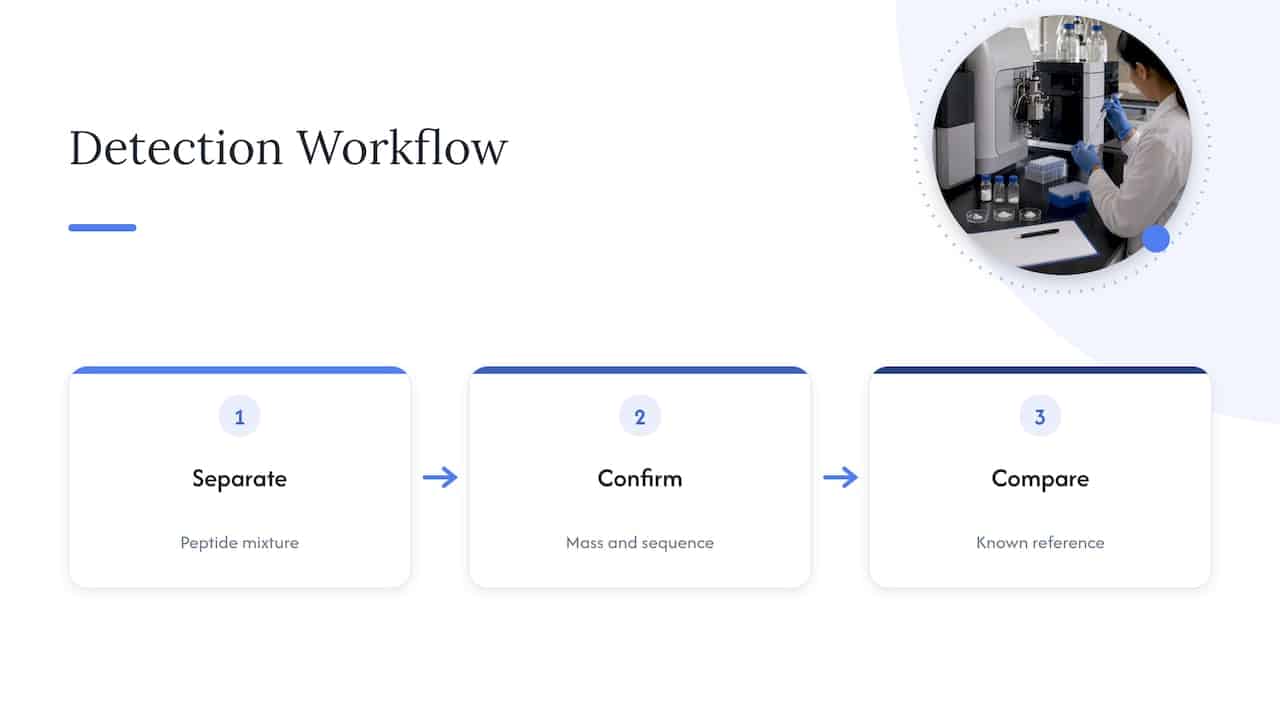
That pattern holds for research reagents as directly as it does for finished pharmaceuticals. A substituted or diluted peptide lot looks identical to a legitimate one until it’s run through HPLC and LC-MS/MS. The detection method is the same regardless of whether the product in question is a finished drug or a research-grade reagent sitting in a freezer: separate it, confirm its mass and sequence, and compare the result against a known reference.
The lesson for a lab building its own verification practice is less about any single incident and more about the consistency of the finding: documentation alone, without instrumental confirmation, has not been sufficient to catch counterfeit material in any of the cases Public Safety Canada reviewed. That is the strongest practical argument for treating a COA as a starting point for verification, not the end of it.
What regulatory and legal frameworks apply to peptide authenticity in Canada?
Peptide authenticity sits at the intersection of a few overlapping frameworks rather than one single regulation written specifically for research reagents. Health Canada’s guidance on labelling and classification for in vitro diagnostic devices emphasizes traceable identification, unique lot numbers, and clear technique descriptions, principles that map directly onto what a defensible peptide COA should contain even outside the diagnostic device context.
Separately, counterfeit goods, including pharmaceuticals, are a recognized enforcement concern documented by Public Safety Canada, which notes that laboratory testing is the mechanism used to confirm a product’s actual composition when authenticity is in question. For research-grade peptides specifically, there is no single Canadian statute that mandates COA format or third-party testing frequency, which puts more weight on a lab’s own procurement policy and on accreditation standards like ISO/IEC 17025 as the practical benchmark for credible verification.
The upshot for a procurement officer or lab manager: compliance obligations tend to attach to what you do with a peptide (a regulatory submission, a diagnostic application, a published study) rather than to the raw act of purchasing it. That makes internal policy, not external mandate, the primary lever you control, and it’s why building verification into procurement, rather than waiting for a regulation to require it, is the more reliable approach.
Why supplier transparency on COAs and fulfillment matters
A COA is only as useful as a lab’s confidence that it reflects the actual vial in hand. That’s why batch-specific COAs for every lot and accessible technical support for questions about method or instrumentation are important. A researcher who can’t get a straight answer about how a purity number was generated has no real way to trust it.
Domestic manufacturing and fulfillment also remove a layer of friction that has nothing to do with chemistry but affects every project timeline: customs delays, import paperwork, and unpredictable transit times all add risk to a study schedule before the material even reaches a bench.
— Admin
How Peptilab fits the verification checklist you just read
Everything in this guide points to the same standard: lot-specific documentation, orthogonal testing where it matters, and a supplier you can actually reach. That’s the standard we built our catalogue of research peptides and cosmetic peptides around, with batch-specific COAs available for every lot, third-party purity verification, and manufacturing and fulfillment handled domestically so your order isn’t sitting in customs while an experiment waits.

- Research Peptides and Cosmetic Peptides, each with a COA tied to its specific lot.
- Lab supplies, including syringes, alcohol wipes, and bacteriostatic water, available from our supplies shop.
- A procurement workflow built around the same checklist outlined above, not a generic purity claim.
| What you need | Where to find it |
|---|---|
| Batch-specific COA | Product page for each peptide lot |
| Lab supplies for handling shipments | Supplies shop |
| Verification checklist for new suppliers | Supplier verification guide |
Request a COA before you order, or start with a sample vial to confirm documentation meets your lab’s standard before committing to a bulk order.
FAQ
What counts as a counterfeit research peptide?
A counterfeit research peptide is one sold under a false identity, at a misrepresented purity, or with a composition that doesn’t match its labelling or COA. This differs from a legitimately degraded or lower-purity product, since the defining issue is misrepresentation rather than quality alone.
Can a certificate of analysis alone confirm a peptide is genuine?
A COA is a necessary starting point but not sufficient on its own. Mass-balance and inter-laboratory comparisons show that orthogonal testing lowers uncertainty well beyond what any single-method COA can demonstrate, so high-impact work should pair a COA with independent verification.
What’s the difference between HPLC and LC-MS/MS for peptide verification?
HPLC separates a sample and shows a purity profile based on retention time, while LC-MS/MS confirms molecular identity through mass and sequence fragmentation. NRC’s proteomics methods typically couple the two because HPLC alone can miss co-eluting impurities that share a peptide’s retention time.
When should a lab request third-party ISO/IEC 17025 testing?
Request accredited third-party testing whenever a lot feeds a regulatory submission, a published study, or any experiment where a false result would be costly to detect later. Accreditation confirms validated methods and traceable results, which reduces the risk of relying on an inaccurate in-house COA.
Does Peptilab provide batch-specific documentation with its peptides?
Yes, every lot sold through our research and cosmetic peptide catalogue ships with a batch-specific COA and is manufactured and fulfilled domestically. Technical staff are available to answer questions about the analytical methods behind each certificate.
Sources
- Proteomics and Mass Spectrometry Laboratory (NRC)
- ANGII-1: Certified reference material of angiotensin II (NRC Digital Repository)
- Canadian research establishes standards for natural products and food testing (NRC)
- Counterfeit pharmaceuticals in Canada (Public Safety Canada)