

HPLC measures chromatographic purity: it separates a peptide from its impurities and reports how much of the detected signal belongs to the target peak. LC-MS confirms identity through mass and, when run in tandem mode, delivers far more sensitive quantification. When your work demands both a purity number and proof of what you actually have, you need both techniques working together, not one standing in for the other.
TL;DR:
- An HPLC purity percentage is the target peak’s share of detected signal, so coeluting impurities can remain hidden; request the full chromatogram and method conditions.
- Use HPLC for routine release only when known impurities separate from the target; confirm identity with mass data and profile impurities using mass spectrometry.
- For plasma or tissue measurements, use tandem mass spectrometry, cleanup, stable isotope peptide standards, and calibration curves prepared in the same matrix.
- HPLC costs less, runs faster, and needs less specialized training; reserve mass spectrometry for identity checks or trace measurements that justify the added expense.
- A complete certificate should pair the HPLC chromatogram and method details with an identity confirming mass spectrum, plus linearity or quantification limit data when relevant.
Table of Contents
- What reversed-phase HPLC shows for peptides
- What LC-MS and LC-MS/MS add beyond a purity number
- Match your laboratory question to the right method
- Practical checklist: setting up analysis, sample prep and reporting
- Validation and matrix effects: what regulatory guidance expects
- Evidence behind the orthogonal approach
- Why our COAs include both chromatographic and mass data
- Sourcing peptides and lab essentials for your bench
- FAQ
- Sources
What reversed-phase HPLC shows for peptides
Reversed-phase HPLC is the workhorse for peptide purity testing, and almost every certificate of analysis you will see leans on it. A typical setup uses a C18 column, an acetonitrile or methanol gradient against a buffered aqueous phase, and UV detection at wavelengths where the peptide backbone absorbs. When a peptide contains tryptophan, tyrosine or phenylalanine, a secondary channel at 280 nanometres picks up aromatic side chain absorbance and gives a useful cross-check.
Purity on an HPLC-based certificate is calculated as the area of the main peak divided by the total integrated area of all detected peaks, expressed as a percentage. That number is only as good as what the detector can see: a UV trace will not flag a co-eluting impurity that shares the main peak’s retention time, and it cannot distinguish a truncated sequence from the full-length peptide if both absorb similarly and elute together. This is the central limitation researchers need to keep in mind when a COA lists a purity figure with no accompanying mass data.
Reading a chromatogram well comes down to a handful of signals:
- Retention time should be reproducible run to run; drift often points to column aging or gradient instability.
- Peak shape matters: a sharp, symmetrical peak suggests a clean separation, while fronting or tailing hints at overloading or secondary interactions with the stationary phase.
- Baseline resolution between the main peak and neighbouring shoulders tells you whether the integration software is drawing an honest line between target and impurity.
- Co-elution is the quiet failure mode: two compounds overlapping so closely that the integrator reports one peak when there are really two.
When you request documentation from a peptide supplier, ask for the full chromatogram, not just the summary purity percentage. The gradient conditions, column type, flow rate and detection wavelength all belong on a proper report, because a purity number without method context is hard to compare against your own results. A primer on peptide chromatography walks through these parameters in more detail if you are setting up your own method rather than interpreting a vendor’s.
What LC-MS and LC-MS/MS add beyond a purity number
Liquid chromatography paired with mass spectrometry keeps the separation step from HPLC but adds a mass analyzer at the end of the column, so every eluting compound is identified by its mass-to-charge ratio rather than just its UV absorbance. Common analyzers in peptide workflows include triple quadrupole instruments for targeted quantification, quadrupole time-of-flight (Q-TOF) systems for accurate mass and screening work, and Orbitrap instruments where high-resolution mass accuracy is the priority. Each platform trades off resolution, speed and cost differently, and the right choice depends on whether you are confirming identity once or quantifying trace amounts repeatedly.
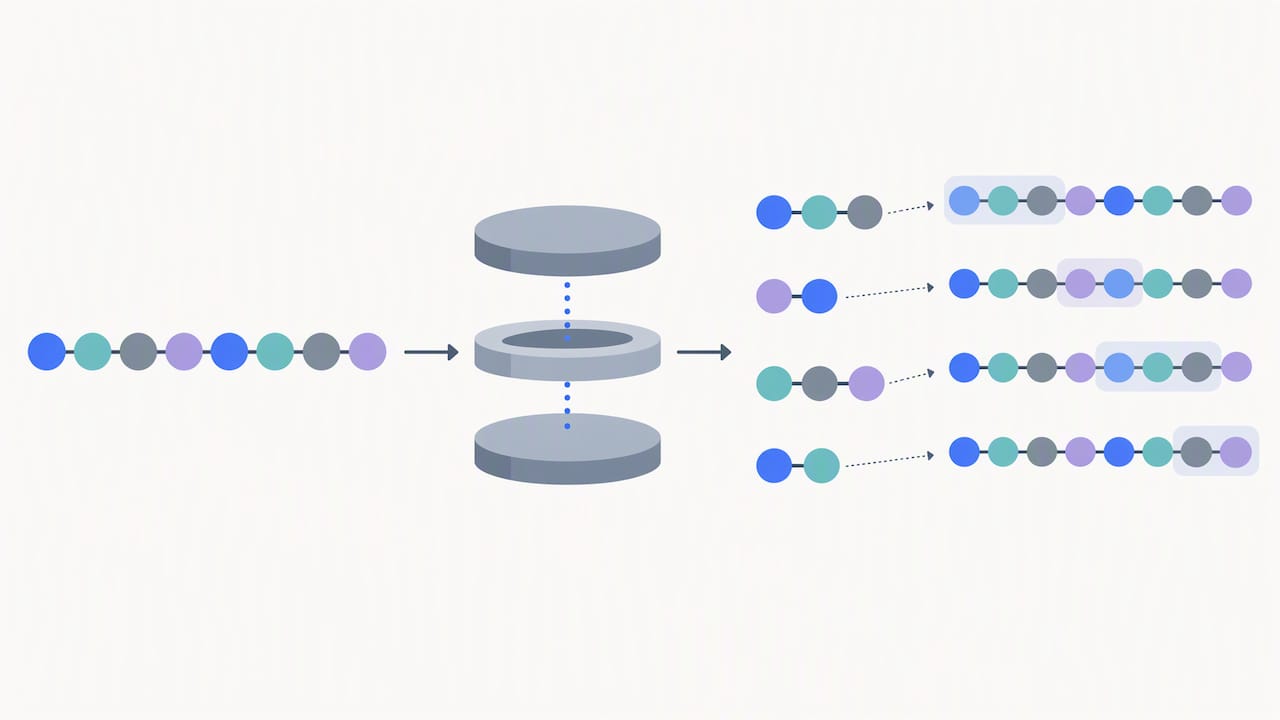
Identity confirmation rests on matching the expected mass-to-charge ratio, checking the isotope pattern against what the sequence predicts, and, for full confidence, generating MS/MS fragment ions that map back to the peptide’s amino acid sequence. This is the step that tells you the peak HPLC called “pure” is actually the peptide you ordered, and not a structurally similar impurity that happens to co-elute and absorb UV light the same way.
For quantification, LC-MS/MS operating in multiple reaction monitoring or selected reaction monitoring mode (MRM/SRM) outperforms UV detection by a wide margin on sensitivity, which is why LC-MS/MS is described in peer literature as a robust option for peptide and protein quantification in clinical and research settings, supporting trace-level detection that UV simply cannot reach.
That sensitivity comes with operational demands:
- Matrix effects from co-extracted biological material can suppress or enhance the ionization signal, distorting quantification if left uncorrected.
- Internal standards, ideally stable-isotope-labelled versions of the target peptide, correct for these effects and for run-to-run variability in ionization efficiency.
- Sample clean-up through solid-phase extraction or protein precipitation reduces the matrix load reaching the ion source before it becomes a problem.
Pro Tip: Run a post-extraction spike alongside your real samples whenever you quantify peptides in a biological matrix: it is the fastest way to catch ionization suppression before it skews your results. For a deeper look at building these workflows, our guide on internal standards in peptide analysis covers calibration strategy in more depth.
Match your laboratory question to the right method
The method you need depends on the question you are asking, not on which instrument happens to be available.
- Batch release purity checks, where the goal is confirming a known peptide meets a purity threshold, are usually well served by HPLC alone, provided the method has been shown to separate known impurities from the target peak.
- Identity confirmation, such as verifying a new synthesis batch or a supplier’s claimed sequence, requires mass data: HPLC cannot tell you what a peak is, only how clean it looks.
- Trace quantification in complex matrices, like measuring a peptide in plasma or tissue homogenate, needs LC-MS/MS because UV detection lacks the sensitivity and specificity to separate the signal from matrix background.
- Impurity profiling, where you need to characterize what the impurities actually are rather than just measure how much of them exists, calls for LC-MS run alongside HPLC so each impurity peak gets both a quantity and an identity.
Cost and throughput diverge sharply between the two approaches. HPLC systems are cheaper to run, faster per sample, and require less specialized operator training, which makes them the practical default for routine release testing. LC-MS instruments cost more to acquire and maintain, need staff experienced in method development and troubleshooting ion suppression, and typically run slower per sample once you account for sample clean-up. The trade-off is worth it the moment your question is about identity or trace-level quantification rather than bulk purity, because no amount of HPLC optimization substitutes for a mass measurement.
Practical checklist: setting up analysis, sample prep and reporting
Before you run anything, define three things: the analytical question (purity, identity, or quantity), the matrix you are working in (synthetic standard, buffer, or biological fluid), and the sensitivity you actually need. These decisions determine everything downstream.
Sample preparation choices have an outsized effect on LC-MS results specifically:
- Simple dilution works for clean synthetic samples but does nothing for complex matrices.
- Solid-phase extraction (SPE) removes salts and small-molecule interferences before they reach the ion source.
- Protein precipitation clears bulk protein from biological samples quickly, though it is less selective than SPE.
- Phospholipid removal cartridges address a specific and common source of ion suppression in plasma-based work.
Internal standard strategy follows directly from matrix complexity: a stable-isotope-labelled version of your target peptide, added before extraction, tracks losses and ionization variability through the entire workflow and anchors your calibration curve.
Pro Tip: Build your calibration curve in the same matrix you are measuring, not in neat buffer, since matrix-matched calibration catches suppression effects that a solvent-only curve will miss.
A complete certificate of analysis should include the HPLC chromatogram with method parameters, the MS spectrum confirming identity, a brief method summary, and linearity or lower limit of quantification (LLOQ) data where quantification is claimed. Our quality control guide for bulk peptide orders sets out what to look for when reviewing a supplier’s documentation against these expectations.
Validation and matrix effects: what regulatory guidance expects
Method validation for peptide analysis generally addresses identification tests, assay and content quantitation, impurity quantitation or limit tests, and linearity across the expected concentration range. ICH Q2(R2) guidance sets out these validation types and recommends orthogonal or independent procedures to demonstrate specificity whenever a single method cannot fully discriminate the target from everything else present.
Detecting matrix effects in LC-MS work typically relies on two experiments:
- Post-column infusion, where a constant flow of analyte is infused while a blank matrix extract runs through the column, revealing regions of ion suppression or enhancement as dips or spikes in signal.
- Post-extraction spike, comparing a matrix sample spiked after extraction against a neat standard, quantifies how much the matrix itself is distorting the signal.
Mitigation follows the same logic used in internal standard selection: stable-isotope-labelled internal standards, matrix-matched calibration curves, and tighter sample clean-up all reduce the practical impact of matrix effects. Combining HPLC purity data with MS identity confirmation strengthens a method’s specificity case precisely because the two techniques fail in different ways, which is the foundation of the orthogonal approach regulators expect.
Evidence behind the orthogonal approach
Reference material work from the National Research Council backs this pairing directly. NRC’s certified reference material documentation for angiotensin II shows HPLC assay remains a primary method for content assignment because of its lower inter-laboratory variability, while LC-MS serves as the gold standard for identity confirmation, with complex samples commonly characterized using both.
A separate NRC case study on oxytocin found that HPLC assay against the same bulk material delivered the lowest inter-laboratory variability of the methods compared, while LC-MS and qNMR proved stronger for structural verification and work in complex matrices. That division of labour, HPLC for consistent quantification, MS for structural confidence, mirrors exactly how peer literature frames LC-MS/MS: as a sensitive, robust option for trace peptide quantification once properly validated.
Why our COAs include both chromatographic and mass data
We provide certificates of analysis for our batches, supporting your quality control workflows with product documentation. This documentation lets you map our documentation directly onto your own method validation and quality control workflows without guessing what a single number actually proves.
— Admin
Sourcing peptides and lab essentials for your bench
Reliable analytical work starts with reliable material, which is why we supply research peptides and cosmetic peptides with third-party COAs, alongside lab essentials to round out your bench.

- Canadian manufacturing and domestic shipping mean no import delays when you need material on a deadline.
- Batch-specific documentation is available on request, so your QC records line up with what you actually received.
- Lab supplies like syringes, bacteriostatic water and alcohol wipes are stocked alongside the peptide catalogue, cutting down on separate vendor orders.
Browse the current catalogue or reach out to our support team for batch documentation before you place an order.
FAQ
What is the difference between LC-MS and HPLC?
HPLC separates compounds chromatographically and reports purity based on UV detection, while LC-MS adds a mass analyzer that identifies each separated compound by its mass. HPLC answers “how clean is this sample,” and LC-MS answers “what exactly is in this peak.”
What is LC-MS/MS analysis of peptides and how does it work?
LC-MS/MS couples liquid chromatography with two stages of mass analysis: the first isolates a precursor ion by its mass-to-charge ratio, and the second fragments it to generate sequence-specific ions. This combination confirms identity and, in MRM or SRM mode, enables sensitive quantification that peer literature documents as a robust approach for clinical and research peptide measurement.
What are the disadvantages of LC-MS?
LC-MS instruments cost more to acquire and operate than HPLC systems, and reliable results demand careful attention to matrix effects, which can suppress or enhance ionization signal if not corrected with internal standards and proper sample clean-up. Method development and troubleshooting also require more specialized operator expertise than standard HPLC purity testing.
Is LC-MS proteomics?
LC-MS is a core analytical technique used in proteomics, but the two terms are not interchangeable: proteomics is the broader study of protein identity, structure and abundance, while LC-MS is one of the main tools used to generate that data. Peptide-level LC-MS/MS work, including sequence confirmation through fragment ions, is a standard proteomics method rather than a synonym for the field itself.
When should a lab choose HPLC over LC-MS for peptide work?
HPLC alone is appropriate when the question is purity against a known, well-characterized target, such as routine batch release testing where impurities have already been identified and separated by the method. Once the question shifts to confirming identity or quantifying trace amounts in a complex matrix, LC-MS becomes necessary because UV detection cannot provide that level of specificity or sensitivity.
Sources
- ANGII-1: Certified reference material of angiotensin II – NRC Digital Repository – Canada.ca
- Survey of peptide quantification methods and comparison of their reproducibility: a case study using oxytocin – NRC Publications Archive – Canada.ca
- LC-MS/MS for protein and peptide quantification in clinical …
- Database