
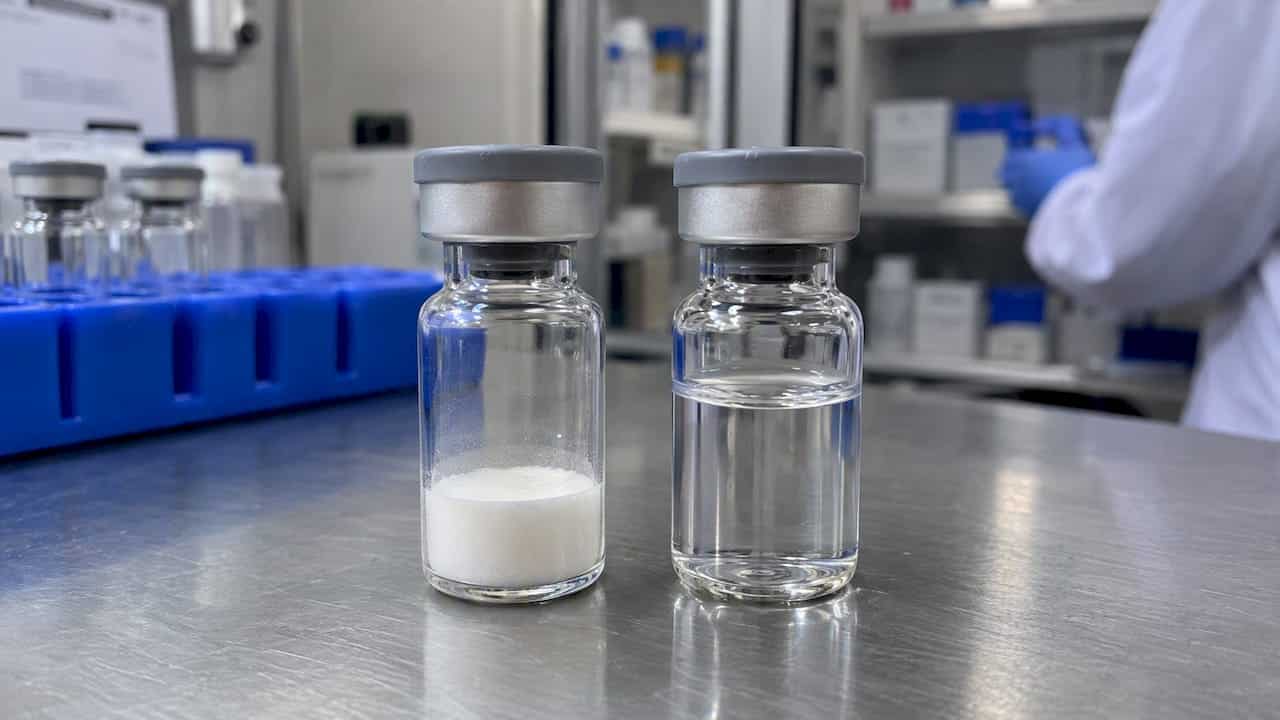
Lyophilized peptides generally win on long-term stability, while solution peptides win on convenience when you can manage cold-chain and use the material quickly. Most sequences degrade faster in aqueous form through oxidation, deamidation and aggregation, but some peptides destabilize during freeze-drying itself or aggregate after reconstitution, so always check sequence-specific data and the certificate of analysis before you decide.
TL;DR:
- Choose a solvent suited to the assay, add it slowly, let the powder dissolve, and mix by gentle swirling rather than vortexing.
- Reconstituted vials often remain usable for only days to a few weeks, depending on formulation and preservatives, so follow sequence specific in use guidance.
- Store powder cool and dry with desiccant; keep liquids continuously at 2°C to 8°C and avoid repeated freeze thaw cycles.
- Check the certificate of analysis and sequence specific stability data: some peptides aggregate after drying, while excipients can interfere with assay chemistry.
- Persistent particulates after gentle centrifugation or any sign of contamination warrant discarding the vial; SEC or DLS can help confirm aggregation.
Table of Contents
- How peptides degrade: comparing chemical and physical stability in solution vs dry state
- How to reconstitute a peptide correctly and verify it before use
- Storage rules and shelf-life: what labs should expect for powder and solution formats
- Formulation strategies and excipients that improve peptide stability
- Practical troubleshooting: aggregation, particulate matter, vial pressure and venting
- Our lab checklist for reducing handling risk from receipt to reconstitution
- Cost differences and economic considerations between lyophilized and solution peptide formulations
- What researchers get wrong about choosing a peptide format
- Where to get research-grade peptides and supplies for safe handling
- FAQ
- Sources
How peptides degrade: comparing chemical and physical stability in solution vs dry state
Water is the main driver of peptide instability. In aqueous solution, peptides are vulnerable to oxidation, deamidation and aggregation, and these pathways accelerate with temperature, light exposure and time. A formulation review of therapeutic peptides in aqueous solutions notes that aggregation is one of the biggest limiters of shelf-life once a peptide is in liquid form, and it is commonly flagged using size-exclusion chromatography.
Removing bulk water through lyophilization slows most of these reactions, which is why freeze-dried powders typically outlast their liquid counterparts on the shelf. But the freeze-drying process is not free of risk. Freezing and drying impose their own mechanical and thermal stresses on a peptide’s structure, and those stresses can promote aggregation once the powder is reconstituted. A review of factors affecting peptide physical stability points out that sequence, concentration, pH, excipients and the lyophilization process itself all interact to determine whether a given peptide holds up.
Think of the dry state as a pause button rather than an off switch. It stops most of the clock, but whatever stress happened during the pause can still show up the moment you press play again.
Researchers diagnosing these changes rely on a small set of established tools:
- Size-exclusion chromatography (SEC) separates species by size and flags aggregates or fragments.
- Dynamic light scattering (DLS) detects particle size distribution shifts that suggest early aggregation.
- Circular dichroism (CD) reveals changes in secondary structure that may precede visible instability.
Aggregation is one of the most common limiters of peptide shelf-life in solution, and researchers studying peptide physical stability rely on SEC, DLS and CD together because no single method catches every failure mode.
How to reconstitute a peptide correctly and verify it before use
Reconstitution is where most avoidable damage happens. Getting the solvent, volume and mixing technique right at this step determines whether your peptide behaves predictably for the rest of the experiment.
- Match the solvent to the downstream assay. Bacteriostatic water suits most general research use, buffered saline suits assays sensitive to osmolarity, and a low-percentage organic cosolvent (such as dilute acetic acid or a small amount of DMSO) helps with poorly soluble hydrophobic sequences.
- Choose a volume that keeps concentration in a safe range. Overly concentrated solutions push peptides toward self-association; overly dilute solutions waste material and complicate downstream handling. Start near the middle of the peptide’s documented solubility range.
- Add solvent slowly down the vial wall and let the powder dissolve on its own for a minute before any mixing.
- Mix gently by swirling or inverting the vial. Avoid vortexing, which introduces shear and air bubbles that can trigger aggregation at the solution’s surface.
- Filter only if the assay demands sterility, using a low-protein-binding syringe filter, and only after confirming filtration does not reduce recovery for that specific peptide.
- Inspect the solution visually for cloudiness, particulates or discolouration before use.
- Log the lot number, reconstitution date, solvent, final concentration and operator initials on the vial and in your lab notebook.
If particulates appear, a short, gentle centrifugation step can tell you whether the issue is loose aggregate (often spinnable out) or something that needs a fresh vial. Our guide to reconstitution best practices walks through solvent selection and technique in more detail for specific peptide classes.
Pro Tip: Reconstitute only the volume you plan to use within your documented in-use window, and keep a second vial lyophilized as backup rather than reconstituting your entire stock at once.
Storage rules and shelf-life: what labs should expect for powder and solution formats
Storage conditions are not interchangeable between the two formats, and treating them the same is a common source of lost material.
- Lyophilized powders store best cool and dry, ideally in a freezer with desiccant protection against ambient moisture.
- Liquid formulations generally need a steady 2°C to 8°C cold chain and should never go through repeat freeze-thaw cycles, which introduce mechanical stress each time.
- Opened or reconstituted vials have a shorter working life than the sealed powder, often measured in days to a few weeks depending on the formulation and any preservatives present.
- Moisture intrusion into a lyophilized cake is a known aggregation trigger, as shown in research on moisture-induced aggregation of lyophilized insulin, which is why desiccant and tight vial seals matter even in a freezer.
Lyophilization is widely used specifically to extend shelf life, according to a review of lyophilization process and excipients, though the review is clear that drying only delivers that benefit when process control and stabilizer choice are handled properly. When you need to push a peptide beyond its documented shelf-life for a specific experiment, a stability-indicating assay, run against a fresh reference standard, is the only defensible way to confirm the material is still fit for use. Our storage guide for lyophilized peptides covers sequence-specific storage considerations in more depth, and our peptide storage rules for the first five minutes after receiving cover what to do the moment a shipment arrives.
Formulation strategies and excipients that improve peptide stability
The excipients mixed into a formulation, whether dry or liquid, often matter as much as the format itself.
- Trehalose and sucrose are common cryoprotectants and lyoprotectants that stabilize peptide structure during freezing and drying.
- Mannitol and other polyols influence cake appearance and how quickly a powder redissolves, though they offer less protective benefit than disaccharides in some formulations.
- Buffers, antioxidants and surfactants are the liquid-side equivalents, controlling pH drift, limiting oxidation and reducing surface-induced aggregation at the air-liquid interface.
- PEGylation and non-covalent PEG strategies are more advanced stabilization approaches that can extend circulating or shelf stability for specific sequences.
A study on pH and excipient effects on exenatide stability found that this peptide’s degradation pathway, and the protective effect of added sugars, shifted markedly depending on solution pH. That is a useful reminder that excipient strategy is sequence-specific rather than universal: what stabilizes one peptide may do little for another.
A review of lyophilization excipients also flags a practical trade-off researchers should weigh before choosing a formulation: disaccharides protect structure but add mass to the cake and can interfere with some downstream assays, while surfactants reduce aggregation but may disrupt cell-based assays at higher concentrations. Before running an experiment, check the excipient list on the certificate of analysis and confirm it will not interfere with your specific assay chemistry. Our guide to pH stability screening outlines how to test a peptide across a pH range before committing to a formulation.
Practical troubleshooting: aggregation, particulate matter, vial pressure and venting
When a vial looks or behaves differently than expected, a short diagnostic sequence saves time and material.
- Inspect visually first. Haze or fine particulates suggest aggregation or precipitation; discolouration or an off odour suggests contamination.
- Confirm with the right assay. SEC and DLS distinguish soluble aggregates from larger particulates, while SDS-PAGE helps rule out degradation fragments.
- Vent pressure carefully. If a vial seems pressurized after reconstitution, release pressure slowly through the septum with a vented needle rather than popping the stopper, and do this inside a clean, controlled area.
- Try gentle remediation only within validated limits. Brief warming to room temperature or a short centrifugation can resolve loose aggregate, but do not force dissolution with heat or sonication beyond what the sequence has been validated for.
- Discard when in doubt. Visible particulates that persist after centrifugation, or any sign of contamination, mean the vial should be discarded rather than used.
- Log the anomaly against the lot number and report it to your supplier with the COA on hand for comparison.
Pro Tip: Keep a simple anomaly log with lot number, date, observation and resolution. It turns one-off problems into a pattern you can spot across shipments. Our guide to peptide stability testing methods covers SEC, DLS and CD setups in more detail for labs building this into a routine QC step.
Our lab checklist for reducing handling risk from receipt to reconstitution
A short, repeatable checklist at receiving catches most problems before they reach your bench.
On arrival, verify the certificate of analysis matches the lot number on the vial, inspect the lyophilized cake for colour and texture consistent with the COA, and record the storage condition the shipment arrived in. Move powders to their documented storage temperature immediately rather than leaving them at room temperature while you finish other tasks.
Once reconstituted, label the vial with the date, final concentration and operator initials, and track the clock on its in-use window from that moment, not from the original receipt date. We publish batch-specific certificates of analysis for every peptide we sell, along with reconstitution and storage guides, so researchers can cross-check their own observations against documented purity and handling data rather than relying on general assumptions.
Cost differences and economic considerations between lyophilized and solution peptide formulations
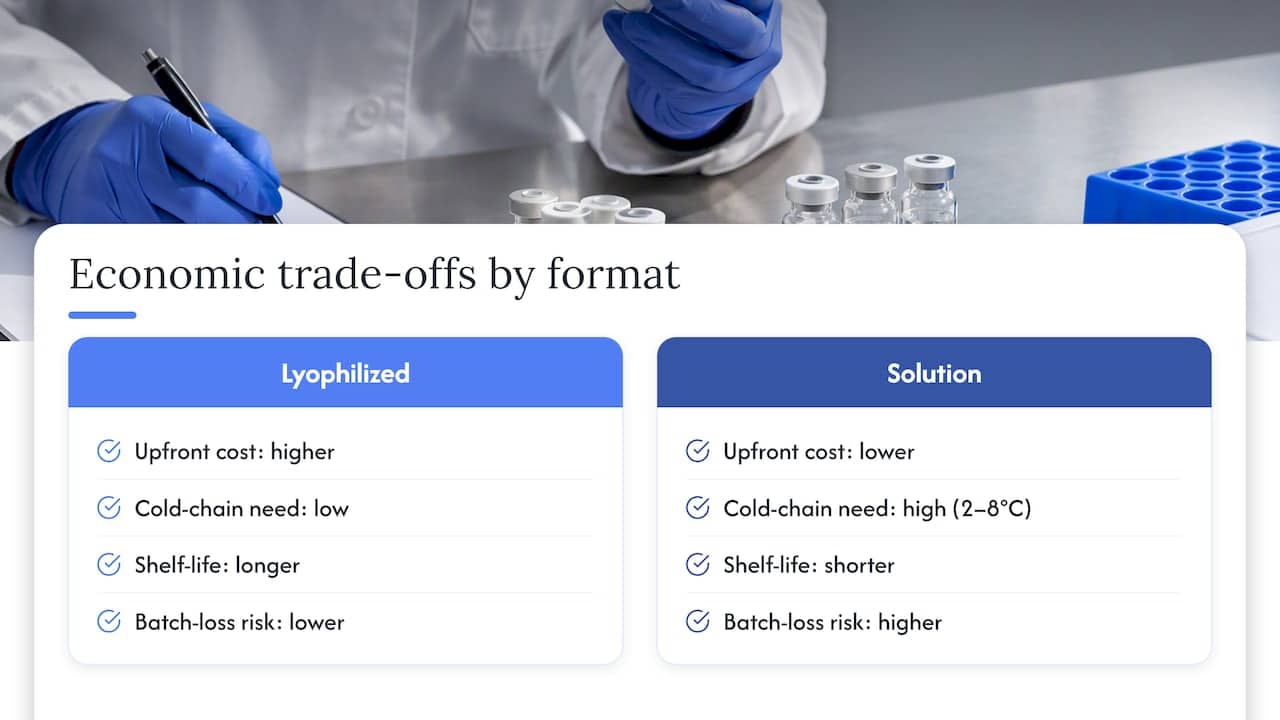
Lyophilized peptides generally cost more upfront to produce because freeze-drying is a slower, more energy- and equipment-intensive process than simply filling a vial with solution. That cost difference often shows up in the price researchers pay, particularly for smaller-batch or specialty sequences.
Solution formulations can look cheaper per vial at the point of sale, but the total cost of ownership depends heavily on how the material is used. A liquid that must be shipped and stored at 2°C to 8°C the entire time carries ongoing cold-chain costs: refrigerated shipping, backup power for freezers, and the risk of a full batch loss if a cold chain fails. Lyophilized powder tolerates brief excursions from its ideal storage temperature far better, which reduces the practical risk of losing an expensive batch to a single freezer malfunction or shipping delay.
For labs that order infrequently or need to stockpile peptides for future projects, the lyophilized format’s generally longer shelf-life often offsets its higher production cost by reducing waste from expired, unused solution. For labs running high-throughput assays where material moves from vial to experiment within days, the convenience of a ready-to-use solution can be worth its added cold-chain overhead. The right economic call depends on order frequency, assay timeline and how much freezer and refrigerator capacity a lab already has, more than on the sticker price of either format.
What researchers get wrong about choosing a peptide format
The most common mistake is treating format choice as a convenience decision alone, without checking whether the specific sequence has documented post-reconstitution behaviour. Some peptides, like certain parathyroid hormone fragments, adopt higher-order structures during the lyophilization process itself that make them sensitive to drying stress and prone to aggregate once reconstituted, a finding borne out in research on lyophilized teriparatide stability. A format that looks safer on paper is not automatically safer for your sequence.
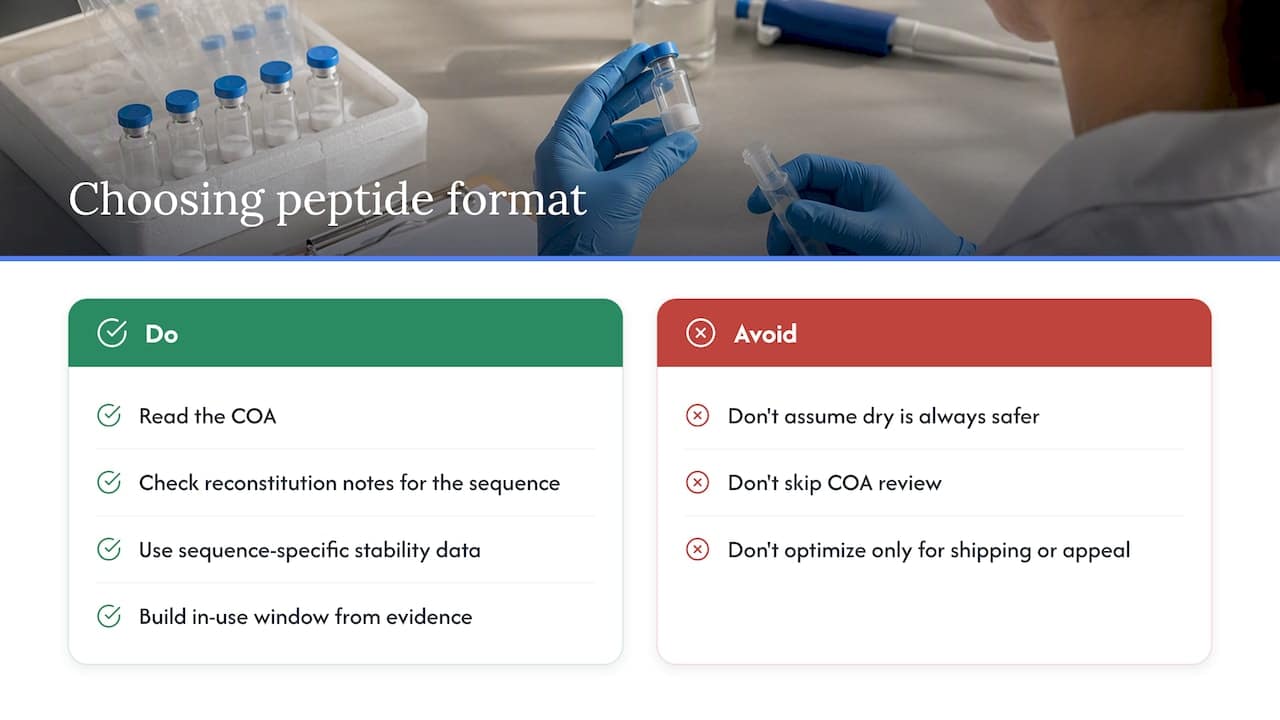
The conventional advice, dry equals stable, liquid equals convenient, holds up often enough to be a reasonable default, but it is not a substitute for checking sequence-specific data. If your experiment depends on a peptide behaving consistently across a multi-week study, the time spent reading the stability data behind your specific sequence is worth more than optimizing for shipping cost or shelf appeal.
Prioritize documentation over habit: read the COA, check for any published reconstitution notes on that sequence, and build your in-use window around evidence rather than a generic shelf-life assumption carried over from a different peptide.
*— Admin *
Where to get research-grade peptides and supplies for safe handling
Choosing the right format matters less if the peptide itself is inconsistent from batch to batch. We supply research-grade and cosmetic peptides, with batch-specific certificates of analysis available for every product so you can verify purity and cross-check handling notes before you reconstitute anything.

Alongside the peptides themselves, we carry the supplies that make reconstitution and aseptic handling easier to get right the first time, including bacteriostatic water, syringes, alcohol wipes, and supporting documentation.
For sequence-specific handling questions, researchers evaluating purity and shelf-life trade-offs for copper-based peptides may also find it useful to review independent storage and COA guidance for GHK Copper Peptide before placing an order. Browse our research and cosmetic peptide catalogue or our supplies page for reconstitution essentials, and reach out to our technical support team for sequence-specific handling advice before your next order.
FAQ
Can you inject lyophilized peptides?
Lyophilized peptides are a dry powder and must be reconstituted into a solution before any use that involves injection, and that use applies only to legitimate research contexts under appropriate protocols. Always follow your institution’s biosafety and handling procedures rather than treating reconstitution as a shortcut to immediate use.
What does a lyophilized peptide do once reconstituted?
Once dissolved in an appropriate solvent, a lyophilized peptide returns to its active solution form for use in the assay or experiment it was intended for. The freeze-drying process itself does not change the peptide’s intended biological or biochemical activity, though drying stress can affect structure and aggregation behaviour in sequence-dependent ways, as shown in research on peptide physical stability factors.
How long will lyophilized peptides last in the fridge?
Lyophilized peptides generally last longer in a freezer than a standard fridge, since cold, dry, stable conditions slow degradation pathways most effectively. Exact shelf-life depends on the specific sequence, formulation and moisture control, so the certificate of analysis and any sequence-specific stability data are the most reliable guide rather than a single universal figure.
Which format should I pick if I’m not sure how quickly I’ll use a peptide?
If your timeline to use a peptide is uncertain or spread over weeks to months, the lyophilized format is generally the safer default because it tolerates storage and shipping stress better than a liquid. Reserve solution formats for situations where you can commit to a strict cold chain and a short, defined in-use window.
Sources
- Designing formulation strategies for enhanced stability of therapeutic peptides in aqueous solutions: a review
- The effects of pH and excipients on Exenatide stability in solution