

Safe peptide handling comes down to four habits: control exposure to the powder, protect the material from degradation, keep sharps and solvents under written procedures, and never treat a research-use vial as a drug. This guide walks through each one for Canadian laboratories and formulation teams, using Health Canada, CCOHS and peer-reviewed sources where a claim can be checked.
Peptilab supplies research-grade and cosmetic peptides to professional researchers, laboratories and formulators. Everything below is written for that audience. It is not medical advice and it is not guidance for personal use.
TL;DR
- Treat every lyophilised peptide as a bioactive material of unknown hazard until the supplier’s documentation says otherwise. Weigh and open powders under engineering controls, not just behind gloves.
- Rank your controls: CCOHS describes a hierarchy that puts ventilation and procedures ahead of personal protective equipment (PPE).
- Storage and reconstitution rules depend on the sequence. Residues such as Cys, Met and Trp need stricter conditions than stable sequences.
- In Canada, injectable peptides sold as products for people are regulated as drugs. Research material is for the bench, never for administration.
Table of Contents
- What “handling safety” actually covers
- Know the hazard before you open the vial
- Controls in the right order
- Receiving and storing peptides
- Reconstitution without losing material or safety
- Spills, exposure and waste
- Canadian regulatory limits you must respect
- Our perspective
- Equipment and materials for the bench
- A one-page handling checklist
- FAQ
- Sources
What “handling safety” actually covers
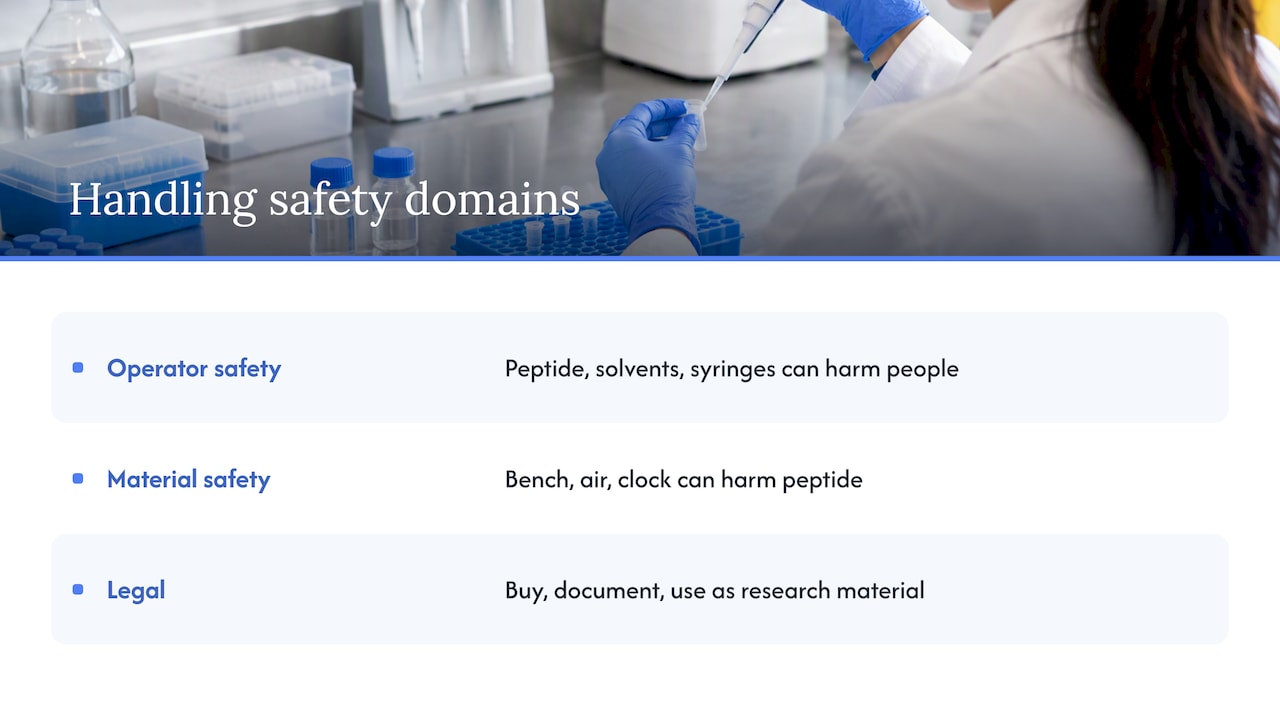
Search results for this topic mix two different problems. One is operator safety: what the peptide, its solvents and the syringes can do to the person at the bench. The other is material safety: what the bench, the air and the clock can do to the peptide. A good procedure covers both, because a degraded or contaminated stock is a hazard to your data, and a careless transfer is a hazard to you.
The third issue is legal. Handling safety in a Canadian lab assumes the material is bought, documented and used as research material. We come back to that in the regulatory section, because it shapes every other decision.
Know the hazard before you open the vial
Most research peptides have no complete toxicology profile. That is the starting point for risk assessment, not a reason to relax. A university biosafety guideline on biologically derived substances lists peptides among materials that can cause systemic toxicity through ingestion, inhalation, skin or mucous membrane exposure. The practical reading: until you know better, assume an uncharacterised peptide is potent.
NIBSC takes the same cautious stance with its own peptide library material. Its storage page notes that the product is not licensed or approved for administration to humans or animals and that a safety data sheet for the investigational material is not available. If an institution that distributes peptides says “use due caution”, a lab using them should too.
Read the paperwork first
Before a new batch reaches the bench, collect three documents:
- Certificate of analysis (COA) for the exact batch: identity, purity and the testing method.
- Safety data sheet (SDS) where one exists, plus SDSs for every solvent and reagent in the workflow. Under WHMIS, hazardous products must carry a label and an SDS, and the SDS must be available at the work site. CCOHS also explains how to read an SDS.
- Your own risk assessment for the procedure: quantity, form (powder or solution), route of possible exposure and the people involved.
If a supplier cannot give you a batch-specific COA, treat that as a procurement problem before it becomes a safety problem. Our guide to peptide procurement risk covers what to ask for.
Controls in the right order
Many labs begin and end with gloves. CCOHS guidance on hazardous chemicals frames safety as a hierarchy of controls: substitute the less hazardous option where you can, then use engineering controls such as ventilation, then administrative controls such as SOPs and training, and only then rely on PPE.
| Level | What it looks like for peptide work |
|---|---|
| Substitution | Buy pre-weighed or pre-aliquoted vials so you never handle bulk powder; use a less hazardous solvent where the method allows |
| Engineering | Weigh and reconstitute in a chemical fume hood or a certified biological safety cabinet |
| Administrative | Written SOPs, training records, labelled storage, restricted access, a sharps plan |
| PPE | Lab coat, safety goggles, gloves chosen for the solvents in use |
Containment and PPE
The Duke guideline recommends primary containment such as a certified Class II biological safety cabinet or a chemical fume hood for potent biologically derived substances, to prevent exposure to aerosols or powders. It also calls for lab coats, safety goggles and gloves selected for the chemicals involved, and for work surfaces covered with absorbent, leak-proof bench pads.
Two details matter in practice:
- Lyophilised powder is light and static-prone. Open vials slowly, keep them inside the hood, and avoid fast air movement across the balance.
- Glove choice depends on the solvent, not the peptide. A glove that suits water or bacteriostatic water may not suit an organic co-solvent. Check the solvent’s SDS and the glove manufacturer’s compatibility data.
Do not forget the synthesis chemicals
If your team synthesises or modifies peptides rather than only reconstituting purchased material, the reagents can be worse than the product. A published evaluation of occupational health hazards of peptide couplers examines the amide bond-forming reagents used widely in synthesis, and reagents such as HATU and DCCI are known to be potent skin sensitizers and corrosive. Gloves verified against the solvent and a fume hood are the baseline, even when the finished peptide looks low-risk. For background on how peptide ingredients reach the market, see our overview of how peptide APIs are manufactured.
Receiving and storing peptides
Storage is where operator safety and material integrity meet. Labelled, segregated, logged storage prevents the mix-ups that cause both bad data and bad accidents.
On receipt:
- Inspect the package and vial seal. Note any damage on the receiving log.
- Match the vial label, lot number and COA.
- Record the date, the storage location and the person responsible.
- Move the vial to the storage condition stated on the COA or label without delay.
Why one rule does not fit every sequence
The most common storage mistake is a single blanket rule. A published set of recommendations for peptide storage and handling notes that sequence determines how sensitive a peptide is: residues prone to oxidation (Cys, Met, Trp) or deamidation (such as Asn-Gly) need stricter environmental control, for example inert gas and lower temperature, than more stable sequences. A fridge is not a universal answer.
A workable set of habits, which you should confirm against the COA for each product:
- Keep vials tightly closed and away from bright light.
- Let a cold vial reach room temperature before opening, so condensation does not wet the powder.
- Avoid repeated freeze-thaw cycles by splitting stock into single-use aliquots.
- Do not shake solutions vigorously. Swirl gently.
- Label every aliquot with the peptide, concentration, solvent, date and initials.
Our sequence-aware storage guide goes deeper on how to classify a peptide by its residues, and the stock solution guide explains how to plan aliquots.
Reconstitution without losing material or safety
Reconstitution is the step with the most hands-on exposure: a sealed vial, a needle, a liquid and a pressure difference. Our full reconstitution best practices article covers the method. The safety points are these.
- Work inside the hood or cabinet with a bench pad under the vial.
- Add diluent to the powder, not down the vial wall. The PMC recommendations note that peptides can adsorb to plastic or glass surfaces, causing unintended concentration losses. For high-precision work, low-adsorption polypropylene or silanized glass vials reduce the effect.
- Dissolve gently. Swirl or roll; do not foam the solution.
- Label immediately. An unlabelled clear liquid in a rack is a hazard in itself.
- Record the preparation: lot, mass, diluent, final concentration, time.
Those records also protect your results. If an assay drifts, a documented preparation lets you rule the stock in or out.
Sharps, wipes and water
Where syringes or needles are part of the method, the Duke guideline says a sharps management plan must be followed. In practical terms: no recapping by hand, a rigid sharps container within arm’s reach, and a rule that sharps never leave the containment area uncapped.
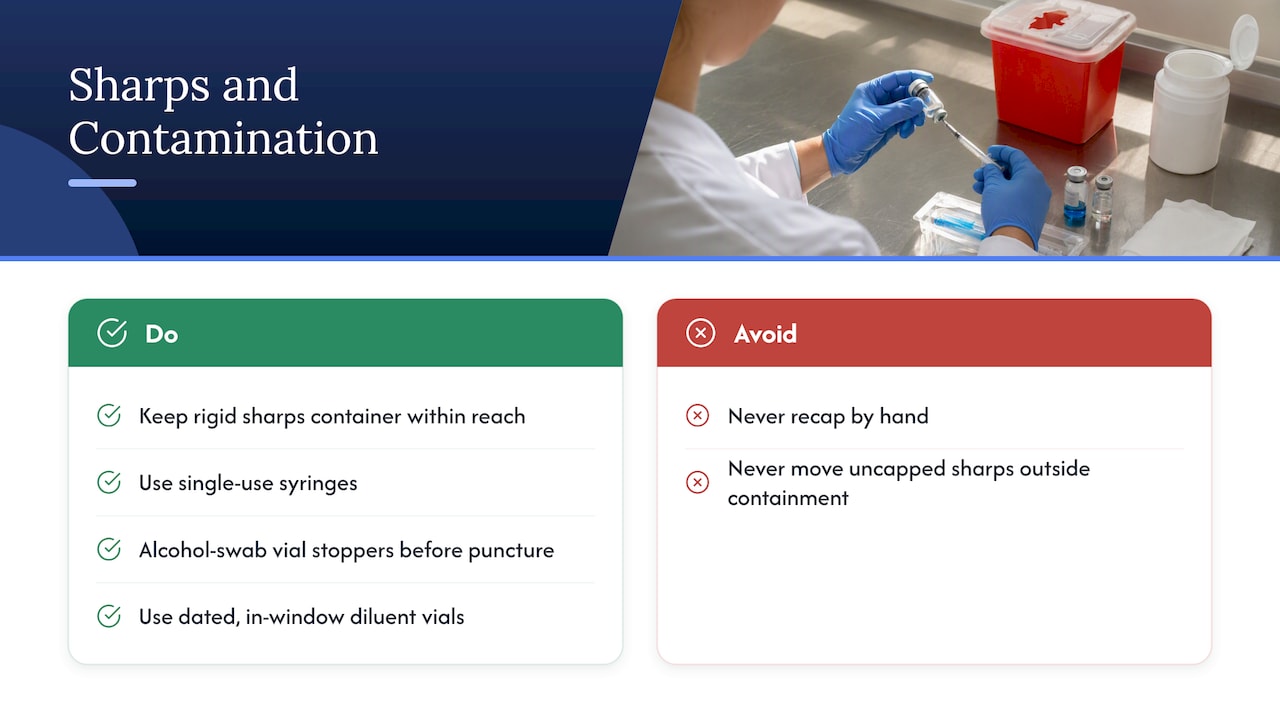
Use single-use syringes, swab vial stoppers with alcohol wipes before each puncture, and draw diluent only from a vial that is dated and within its stated use window once opened. Contamination is the failure the handling steps exist to prevent, and our contamination prevention practices guide lists the typical entry points.
Spills, exposure and waste
Write these procedures before you need them.
- Powder spill: do not sweep dry. Cover with damp absorbent material, wipe inward, and bag the waste. Keep others out of the area until it is clean.
- Solution spill: absorb, then clean the surface with the decontaminant your SOP names.
- Skin or eye exposure: rinse promptly and follow your institution’s first aid and incident reporting procedure. Bring the SDS and COA to occupational health or a physician. If someone has a reaction after exposure, a healthcare professional should assess it, not the lab.
- Waste: dispose of vials, needles and contaminated materials through your institution’s chemical and sharps streams, following its environmental health and safety office. Do not pour stock solutions down the drain unless your EHS office has approved it for that substance.
Train everyone who enters the area, including students and temporary staff, and keep a signed record.
Canadian regulatory limits you must respect
This is the part many guides skip. In Canada, Health Canada has repeatedly warned about unauthorized injectable peptide drugs seized from online and physical retailers. It states that these products have not been assessed for safety, efficacy or quality, and that they carry risks such as infection, allergic reaction and contamination. Its advice to the public is to buy prescription drugs only from licensed pharmacies and to look for a DIN, NPN or DIN-HM on the label.
Other notices describe similar seizures and online sales, including an Alberta clinic, an online seller and a fitness retailer. The lesson for a laboratory is simple:
- Research material is bought, labelled and used as research material only. It is not for administration to people or animals.
- Keep purchase records, COAs and a documented research purpose for every lot.
- If your work moves toward human use, it moves into a different regulatory pathway that needs the appropriate Health Canada authorizations. That is a question for your regulatory affairs lead or counsel, not for a supplier.
Anyone who has used an unauthorized injectable product and has health concerns should speak to a physician, nurse practitioner or pharmacist, as Health Canada advises.
Our perspective
We built Peptilab for people who handle peptides as materials: researchers, laboratories, formulators and manufacturers. From that vantage, three things stand out.
First, safety starts at purchasing. A vial with a batch-specific COA, third-party purity testing and a clear research-use label is easier to handle safely than one with no paperwork, because you know what you are weighing and what to store. That is why every batch we list is third-party tested and comes with a COA.
Second, domestic supply removes avoidable risk. Canadian manufacturing and fulfillment means no cross-border customs holds and shorter transit, so fewer vials sit in uncontrolled conditions on the way to you.
Third, procedures beat products. The best supplier cannot compensate for an unwritten reconstitution method or an unlabelled aliquot. Write the SOP, train people on it, and audit it. Our resources on batch consistency and quality control for bulk orders are meant to help with that.
— Admin
Equipment and materials for the bench
If you are setting up or restocking, we carry the essentials alongside our peptides: syringes, alcohol wipes and bacteriostatic water, and research and cosmetic peptides with COAs. Browse the supplies category for lab consumables or start from the Peptilab catalogue for research-grade and cosmetic peptides. Formulation teams can also read our guide to testing peptide cosmetic product stability.
A one-page handling checklist
Print this and adapt it to your SOP.
- Batch COA and SDS on file before first use
- Risk assessment signed for the procedure
- Weighing and reconstitution inside a hood or cabinet
- PPE matched to the solvents, not only the peptide
- Diluent added to the powder, not the vial wall
- Aliquots labelled with name, concentration, solvent, date, initials
- Storage matched to the sequence and the COA
- Sharps container in reach, no hand recapping
- Spill kit and waste route known to everyone
- Use limited to the documented research purpose
FAQ
What are the risks associated with peptides in the lab?
The main risks are inhaling or contacting the powder, needle-stick injuries, reactions to solvents and reagents, and contamination of the stock. Many research peptides have incomplete toxicology, so assume potency until documentation says otherwise and work in a hood or cabinet.
What happens if peptides are not refrigerated?
It depends on the sequence. Peptides with residues prone to oxidation or deamidation degrade faster, and a one-size-fits-all approach is a common mistake. Follow the storage condition on the COA, and discard or re-test material that has been out of range for an unknown period.
Which peptide is safe to use?
No peptide is safe in general; safety depends on the exact compound, dose, route and context. Health Canada says unauthorized injectable peptides have not been assessed for safety. For any human health question, ask a physician or pharmacist.
Do I need an SDS for research peptides?
You need an SDS for every hazardous product and solvent in your workflow, as WHMIS requires. For some investigational peptides no SDS exists, as NIBSC notes for its own material. In that case your risk assessment should assume higher hazard and say so.
Sources
- Unauthorized injectable peptide drugs seized and sold by Canada Peptide, Health Canada
- Unauthorized injectable peptide drugs seized from Optimum Wellness Centre, Health Canada
- Unauthorized injectable peptide drugs sold by Prime Research, Health Canada
- Unauthorized health products seized at Rize Fitness, Health Canada
- Biologically-derived substances guideline, Duke University
- Hazardous chemicals publication, CCOHS
- Understanding safety data sheets, CCOHS
- WHMIS 2015, WorkSafeBC
- Recommendations for storage and handling of peptides, PMC
- Occupational health hazards of peptide couplers, PMC
- Peptide storage, NIBSC