

Write peptide sequences from the N-terminus to the C-terminus, and number residues starting at the N-terminal end. The IUPAC/JCBN recommendations govern three-letter and one-letter amino acid codes, while the PCT sequence listing standard governs formal submissions. Every modification, whether a phosphate group or a blocked terminus, needs explicit annotation rather than an assumed default.
TL;DR:
- Use three letter codes in manuscript prose and single letter strings in databases; manually check short conversions because Asn and Asp differ by one letter.
- Define every nonstandard abbreviation where it first appears; conventions for phosphorylation, synthetic residues, and branches are not universal, even when specialists recognize them.
- For patent or regulatory submissions, use the PCT format and pair the sequence with a feature table; Canadian filings require electronic listings.
- For branched or multiply crosslinked peptides, add explicit attachment locants and consult a structure file, since a single text string may omit connectivity.
- Flag each D residue at its exact position, and compare supplier sequence labels with certificates of analysis and mass spectrometry traces for that batch.
Table of Contents
- Sequence direction and residue numbering
- Three-letter versus one-letter amino acid codes: when to use each
- Notation for modifications and post-translational changes
- Fragment and cleavage nomenclature
- Cyclic peptides and special topology nomenclature
- Formal standards and sequence listing requirements
- Practical abbreviations and worked examples
- Verifying sequence labels against documentation and COAs
- Distinction between linear and branched peptide notation
- Naming conventions for synthetic and non-natural amino acids
- Handling of stereochemistry and chirality in peptide names
- Use and notation of protecting groups in peptide sequences
- Guidelines for representing peptide mixtures or isomers
- Examples of peptide naming in published literature and databases
- What the standards get right, and where researchers still get tripped up
- FAQ
- Sources
Sequence direction and residue numbering
A peptide sequence reads left to right from the N-terminus (the free or modified amino group end) to the C-terminus (the carboxyl end). Residue 1 is always the N-terminal residue, and every later position counts forward from there. This matters the moment you describe a fragment: a notation like (1-29) means positions 1 through 29 counted from the N-terminus, not an arbitrary internal window.
The IUPAC/JCBN standard sets this left-to-right, N-to-C convention as the baseline for both three-letter and one-letter representations. When a terminus carries a chemical modification, the modification is shown at that end rather than left implicit. An acetylated N-terminus is written with an “Ac-” prefix before residue 1, and a C-terminal amide is shown with a trailing “-NH2” after the last residue. Dropping either marker tells a reader the terminus is unmodified, a free amine or a free acid, so the marker carries real information. Getting the direction or the terminal state wrong changes what the name actually describes, not just how it looks on the page.
Three-letter versus one-letter amino acid codes: when to use each
Three-letter codes (Ala, Gly, Lys) are the default for methods sections, manuscript text and anywhere a human reader benefits from unambiguous, spaced-out symbols. One-letter codes (A, G, K) exist for compact listings: database entries, sequence alignments and large tables where three-letter strings would be unwieldy. The IUPAC amino acid nomenclature page fixes both symbol sets and the contexts each suits.
A handful of one-letter codes carry special meaning. “X” or the three-letter “Xaa” denotes an unknown or unspecified residue. “U” represents selenocysteine, a less common but proteinogenic residue. “O” represents pyrrolysine, found in a small number of organisms. These reserved symbols appear rarely in standard peptide work, but mistaking one for a typo, rather than a deliberate marker, is an easy misread.
Converting between formats is mechanical but worth double-checking by hand on anything short enough to verify quickly, since a single transposed letter (Asn versus Asp, N versus D) changes the molecule. When you move a sequence from a methods paragraph into a database submission or a supplier order, confirm the format matches what that destination expects: journals typically want three-letter codes in running text, while sequence databases and alignment tools expect the one-letter string.
Notation for modifications and post-translational changes
Modified residues need a notation that cannot be mistaken for the parent amino acid. Phosphorylation is commonly shown with bracket notation such as [pSer] or [pTyr], though peer-reviewed work on phosphorylated amino acid annotation notes there is no single universally adopted text code for every modification. Several bracket and multi-letter conventions coexist in the literature, which means the shorthand you use only works if you define it.
Terminal modifications follow the same logic as unmodified termini: “Ac-” before the sequence marks N-terminal acetylation, and “-NH2” after it marks C-terminal amidation. D-amino acids are typically flagged with a lowercase prefix or an explicit “D-” before the residue code (D-Ala, for example), distinguishing them from the default L-configuration. Non-proteinogenic residues, like aminoisobutyric acid or ornithine, usually need a defined abbreviation the first time they appear, since no universal one-letter code covers them.
The practical rule across all of this: define any nonstandard shorthand in the manuscript, dataset or product listing where it first appears. A bracket or prefix that is obvious to you may not be obvious to a reader working from a different lab’s convention, and an undefined symbol is functionally no different from an undocumented sequence.
Fragment and cleavage nomenclature
Fragments are described by their residue range, counted from the N-terminus of the full sequence, such as “residues 5-12” for an eight-residue internal piece. This keeps fragment references consistent with the whole-sequence numbering established earlier, rather than restarting a new count for the piece.
Mass spectrometry uses its own fragment ion labels layered on top of this numbering. The Roepstorff-Fohlman-Biemann scheme assigns a, b and c labels to N-terminal fragment ions, and x, y and z labels to C-terminal fragment ions. Reporting an ion as “y7,” for example, only means something once it is mapped back to a specific residue position in the parent sequence, so methods sections and figure legends should state both the ion label and the corresponding residue range rather than one alone.
Cyclic peptides and special topology nomenclature
Linear N-to-C notation breaks down once a sequence closes into a ring or carries side-chain crosslinks. IUPAC recommendations on cyclic peptide nomenclature extend the standard with prefixes such as “cyclo,” “anhydro” and “epoxy,” alongside CIP priority rules that fix a consistent starting point and direction for numbering around the ring.
Disulfide bridges and other side-chain crosslinks are typically denoted with locants referencing the two residue positions involved, rather than left to be inferred from context. For a simple head-to-tail cycle or a single disulfide, text notation can stay unambiguous. For branched or multiply crosslinked topologies, text alone often cannot convey the full connectivity, and a structure file or canonical connection table becomes the more reliable record alongside the written name.
Formal standards and sequence listing requirements
Two bodies of rules govern formal peptide naming. The IUPAC/JCBN recommendations set the baseline for systematic naming, symbol sets and sequence direction used across research publishing. The PCT sequence listing standard governs patent and regulatory submissions, and CIPO’s guidance on biological sequence listings follows that standard directly: modified or unknown residues are represented with the ambiguity symbol “X” or “Xaa” in the main sequence, with details supplied in a separate feature table. Canadian patent rules now require these listings in electronic, PCT-compliant format, with paper listings no longer accepted for sequence data. Researchers preparing a patent or regulatory filing involving a peptide sequence should build the feature table alongside the sequence itself rather than as an afterthought, since reviewers expect the two to match exactly.
Practical abbreviations and worked examples
A short set of abbreviations covers most synthesis and labelling contexts researchers encounter day to day.
- Ac: acetyl group, commonly used to cap a free N-terminus.
- Boc and Fmoc: temporary protecting groups used during solid-phase synthesis.
- 5-FAM and TAMRA: common fluorescent labels attached to synthetic peptides for tracking or assay work.
- -NH2: C-terminal amidation, replacing a free carboxylic acid.
- [pSer], [pTyr]: bracket notation for phosphorylated serine or tyrosine, used when the authors define it explicitly.
A three-letter sequence such as Tyr-Gly-Gly-Phe-Leu converts directly to the one-letter string YGGFL, with no information lost in either direction. Adding a modification keeps the same backbone but inserts the bracket or prefix at the relevant position: Ac-Tyr-Gly-Gly-Phe-Leu-NH2 shows an acetylated N-terminus and an amidated C-terminus on the same core sequence.
Before submitting a sequence for publication or deposition, confirm the direction is N to C, the code format matches the destination’s convention, every modification is bracketed or prefixed consistently, and any nonstandard shorthand is spelled out once in the text.
Verifying sequence labels against documentation and COAs
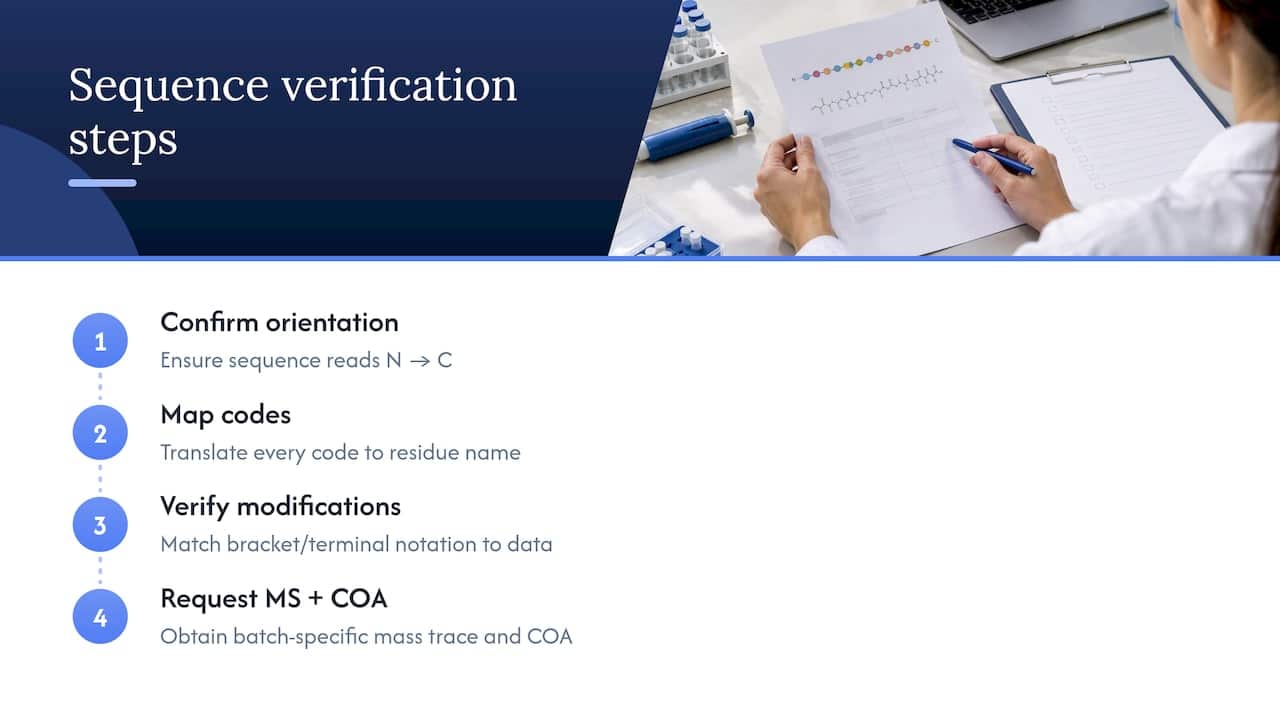
A written sequence name is only as good as the documentation behind it. A practical check runs through four steps: confirm the stated orientation is N to C, map every code to its full residue identity, check that bracket or terminal modification notation matches what the analytical data actually shows, and request the mass spectrometry trace alongside a certificate of analysis for the specific batch.
Machine-readable identifiers from UniProt, Peptipedia or the PDB reduce this risk further, since peptide names frequently carry multiple aliases across sources while the underlying sequence record stays fixed. Our sequence verification guide walks through matching a supplier’s stated sequence against its COA and analytical trace, and every batch we list carries certificate of analysis documentation for exactly this kind of cross-check.
Distinction between linear and branched peptide notation
Linear peptide notation assumes a single unbroken chain from N-terminus to C-terminus, with no attachment points off the backbone. The vast majority of sequence names in the literature describe this simple case, and the standard left-to-right, N-to-C convention applies without qualification.
Branched peptides carry at least one additional chain attached through a side group, typically the epsilon-amino group of a lysine residue, rather than through the standard backbone peptide bond. Writing a branched sequence as a single linear string loses the branch point entirely, so branched notation needs a way to flag where the second chain attaches and what that chain contains. Common practice is to describe the main chain in standard N-to-C order, then specify the branch chain separately with an explicit locant identifying the attachment residue, such as “branch at Lys4.”
Dendrimeric and multi-antigenic peptide constructs push this further, with several identical or near-identical branches radiating from a central core. Text notation alone becomes unwieldy past a simple two-branch case, and these structures are usually better represented with a diagram or a structure file referenced alongside a shorthand name, rather than forcing the full topology into a single text string. When a branched construct does appear in running text, naming the core, the attachment residue and each branch chain separately avoids ambiguity far more reliably than any single compact string.
The practical consequence for researchers reading supplier documentation or literature sequences: if a name includes a branch descriptor or an unusual locant that does not fit the simple N-to-C pattern, treat that as a signal to check the structure file or product documentation before assuming you have read it correctly.
Naming conventions for synthetic and non-natural amino acids
The 20 proteinogenic amino acids all have fixed three-letter and one-letter codes under the IUPAC standard. Synthetic and non-natural residues, aminoisobutyric acid, ornithine, citrulline, various beta-amino acids and D-configured residues among them, do not have a single universal one-letter equivalent, so they rely on established three-letter or multi-letter abbreviations instead.
Many non-natural residues have settled on a conventional three-letter shorthand through repeated use in the synthesis literature rather than through a single formal ruling: Aib for aminoisobutyric acid, Orn for ornithine, Cit for citrulline. These are widely recognized within peptide chemistry circles but still benefit from a one-line definition the first time they appear in a given paper or product listing, since a reader working outside that specific subfield may not recognize the abbreviation on sight.
When a non-natural residue has no established shorthand at all, the common fallback is to spell out the chemical modification in full at first use, then introduce a working abbreviation for the rest of the document. This is the same logic that governs undefined PTM brackets: an abbreviation is only useful once its meaning is fixed in writing, since no universal lookup table covers every non-natural residue researchers now work with. Supplier catalogues and synthesis order forms should carry the same defined shorthand as the accompanying analytical documentation, so a name on a vial label matches the name on its certificate of analysis without requiring the buyer to guess at an undocumented convention.
Handling of stereochemistry and chirality in peptide names
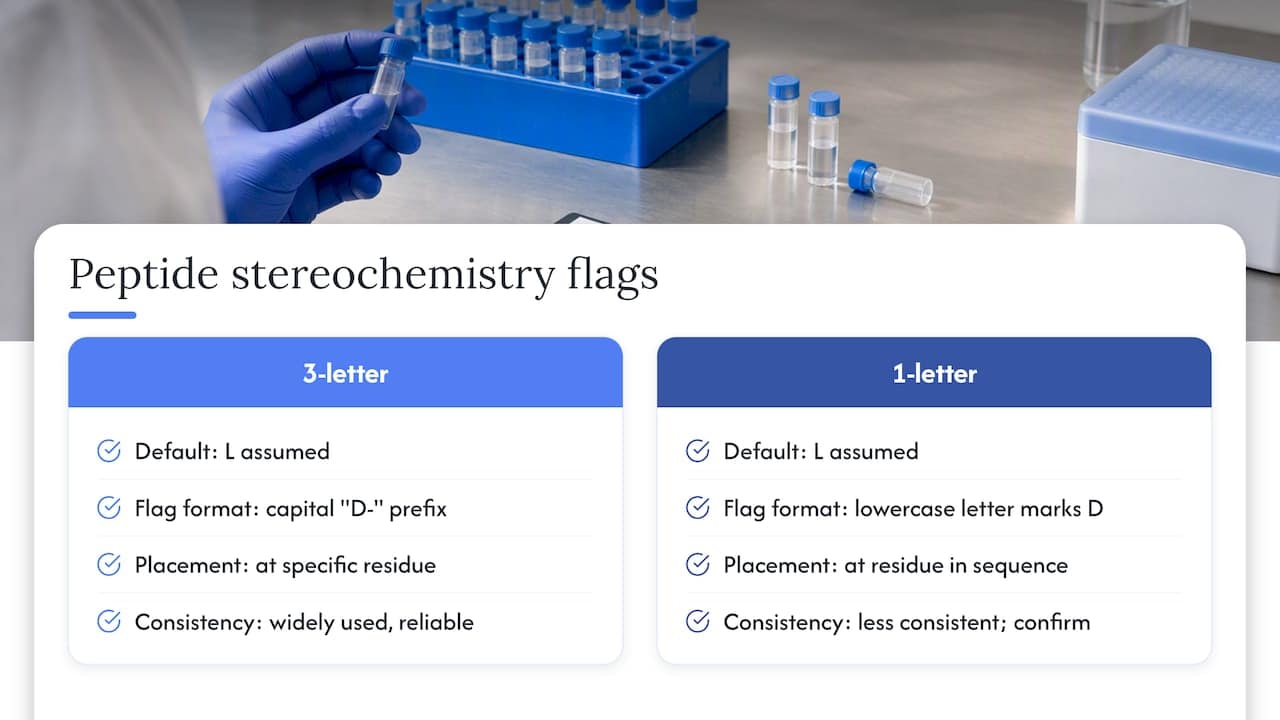
Standard three-letter and one-letter amino acid codes assume the L-configuration by default. This default is almost never written out explicitly, since L-amino acids make up the overwhelming majority of residues in natural and synthetic peptides, and the convention exists precisely so researchers do not need to mark the common case every time.
D-amino acids, the mirror-image configuration, need an explicit flag wherever they occur, because without one a reader will assume the standard L-form. The common approach prefixes the residue with a capital “D-” directly before the three-letter code, as in D-Ala or D-Phe, placed at the specific position in the sequence where the substitution occurs rather than as a general note elsewhere in the text. Some synthesis literature instead uses a lowercase one-letter code to flag a D-residue within an otherwise capitalized one-letter string, though this convention is less consistent across sources than the three-letter prefix and is worth confirming against the source document rather than assumed.
Chirality matters beyond a simple labelling exercise, since a D-substituted peptide can behave very differently from its all-L counterpart in a research assay, which is exactly why the flag needs to sit at the specific residue position rather than as a footnote. A sequence containing even one D-residue should never be written using the unflagged standard code at that position, since doing so silently implies the natural L-configuration and misrepresents the actual molecule. When reading a supplier’s stated sequence or a published peptide name, treat an unflagged code as a claim that every residue is in the standard L-configuration, and treat any D-flag as a detail that should be cross-checked against the accompanying analytical data rather than taken on faith from the name alone.
Use and notation of protecting groups in peptide sequences
Protecting groups are temporary chemical shields attached during solid-phase synthesis to block a reactive side chain or terminus while the rest of the molecule is built up, and they are removed before the final product is isolated. Boc (tert-butyloxycarbonyl) and Fmoc (fluorenylmethyloxycarbonyl) are the two dominant strategies for temporary alpha-amino protection, and each defines an entire synthesis workflow built around its specific deprotection chemistry.
Within a synthesis scheme, protecting group abbreviations are typically written as a prefix directly attached to the residue they shield, distinguishing the protected intermediate from the final deprotected product described in the finished sequence name. This distinction matters most in methods sections describing the synthesis route itself, where the protected intermediate’s name is a real part of the experimental record, rather than in a product listing or database entry describing the finished, fully deprotected peptide.
A finished, purified peptide intended for research or cosmetic use should not carry protecting group notation in its stated sequence name at all, since those groups are removed as part of standard synthesis and purification. If a protecting group abbreviation does appear on a product label or specification sheet, that is a signal worth checking directly with the supplier, since it may indicate an intermediate or custom-synthesis product rather than a finished, ready-to-use peptide. Reading a synthesis methods section carefully, with protecting group names treated as process detail rather than final product identity, keeps the distinction between the synthesis route and the finished molecule clear.
Guidelines for representing peptide mixtures or isomers
A single peptide name describes one defined sequence with one defined set of modifications. Mixtures, several related sequences or isomeric forms present together, need a notation that makes clear more than one species is present, rather than a single compact name that implies a pure, single compound.
Positional isomers, where a modification such as phosphorylation could sit on more than one residue within the same peptide, are a common source of this kind of ambiguity. Peer-reviewed work on phosphorylated amino acid annotation notes that bracket notation for a phosphorylated residue is only unambiguous when the bracket sits at a specific, confirmed position, since an unlocalized phosphorylation (known to be present somewhere on the peptide but not pinned to one residue) needs its own distinct notation rather than being written as though the position were confirmed.
Racemic mixtures or preparations containing both D- and L-forms of the same residue at a given position should state that explicitly in the product or methods description, rather than defaulting to either the plain code or a single D-flag, both of which would misrepresent a true mixture as a single defined stereochemical form. The same logic extends to crude synthesis mixtures containing truncated or deletion sequences alongside the target peptide: analytical documentation, typically an LC-MS trace, is the only reliable way to state what a given vial actually contains, and the stated sequence name should be read as the target compound rather than a guarantee of the vial’s full composition absent that supporting data. Our analytical techniques guide covers the methods, including LC-MS and NMR, that labs use to confirm which species a given sample actually contains.
Examples of peptide naming in published literature and databases
Published peptide names vary more across sources than researchers new to the field often expect. Peptipedia v2.0 documents that peptides commonly carry multiple names across different papers and databases, and recommends relying on validated sequence records and stable identifiers rather than on names alone when precision matters. This is a direct consequence of naming history: a peptide first characterized decades ago under one name may be re-annotated, renamed or cross-referenced under a database identifier later without the original name disappearing from circulation.
Thymosin beta-4 is a widely cited example of this aliasing pattern, with “TB-500” circulating in commercial and research contexts as an informal name tied to the same underlying sequence that formal literature identifies by its systematic name. A comparison of TB-500 and thymosin beta-4 naming walks through exactly this kind of alias confusion, and the pattern repeats across other research compounds where a commercial shorthand and a systematic name both describe the same sequence.
Database entries resolve this by anchoring a name to a stable identifier rather than treating the name itself as the definitive reference. A UniProt or PDB entry links a given sequence to one accession number regardless of how many aliases exist in the surrounding literature, and a published methods section citing that accession number alongside the written sequence name gives a reader an unambiguous way to confirm exactly which molecule is under discussion. When a product listing, a paper or a database entry gives both a name and an identifier, the identifier is the more reliable reference to cite and cross-check, with the name serving as the human-readable label for everyday communication.
What the standards get right, and where researchers still get tripped up
The formal standards are not the problem. IUPAC’s N-to-C convention and three-letter and one-letter codes are clear, stable and have barely changed in decades. Where things go wrong is almost always downstream of the formal rule: an undefined bracket notation copied from one paper into another without its original context, a D-flag dropped during a copy-paste between a methods section and a product listing, or a commercial alias treated as interchangeable with a systematic name when the underlying sequence actually needs a database accession number to confirm.
The gap readers underestimate is how much peptide naming leans on social convention rather than hard rule. PTM bracket notation, non-natural residue abbreviations and branch descriptors all have common usage patterns that most working peptide chemists recognize, but none of them carries the same formal weight as the IUPAC base standard. Treating a widely used shorthand as though it were an official rule, rather than a convention that still needs defining on first use, is where most real-world misreading happens, not in the N-to-C direction itself, which almost nobody actually gets wrong.
— Admin
FAQ
What is the sequence of a peptide?
A peptide’s sequence is the ordered list of its amino acid residues, written from the N-terminus to the C-terminus using either three-letter or one-letter codes. Any modification, such as a phosphorylated residue or an amidated terminus, is shown with explicit bracket or prefix notation rather than left implied.
Which type of peptide starts with the letter “T”?
Several well-known research peptides use names beginning with “T,” including thymosin-family peptides such as thymosin beta-4 and various synthetic peptides whose systematic or trade names happen to start with that letter. The naming pattern itself is informal rather than rule-based, so the starting letter reflects the specific compound’s assigned name, not a category of peptide.
Which peptide to start with?
There is no single peptide that suits every research purpose, since the right starting point depends on the research question, the target pathway and the experimental model involved. Researchers typically select a peptide based on published characterization data for that specific sequence, then verify the supplier’s certificate of analysis before ordering.
Can you give me some examples of peptides that start with the letter “L”?
Peptide names beginning with “L” appear across several research categories, though which specific examples are relevant depends on the research area in question. Checking a validated database record, such as a UniProt or Peptipedia entry, for the specific compound under discussion is more reliable than relying on an alphabetical listing of names alone.
Sources
- IUPAC amino acid nomenclature
- CIPO guidance on patent biological sequence listings
- Proposal of the annotation of phosphorylated amino acids and peptides using biological and chemical codes (PMC)