
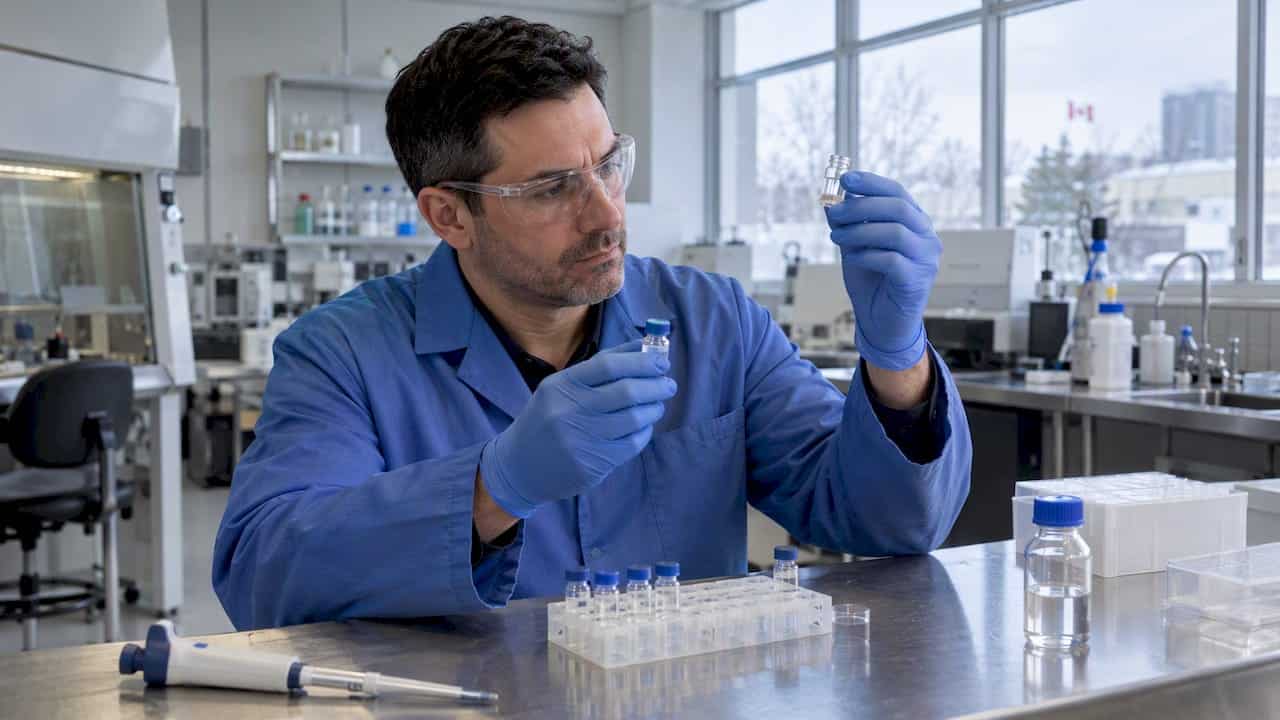
Preservatives can enable safe multidose use of peptide products, but they are not mechanically inert, and no single preservative works across every sequence. The right move is practical, not theoretical: define the route and container first, then run a preservative compatibility screen alongside antimicrobial effectiveness testing on the final dosage form before you trust any multidose vial.
TL;DR:
- Different preservatives interact with peptides through specific mechanisms and are highly sequence-dependent, making pre-screening essential before use.
- Visual signs such as turbidity or particle increase after reconstitution indicate potential aggregation risks from preservative-peptide interactions.
- Use preservative effectiveness testing on the final dosage form and adopt the lowest effective concentration to minimize peptide degradation.
- Proper storage, aseptic reconstitution, and limiting withdrawals help reduce contamination risks that preservatives are meant to mitigate.
- Container choice and route of administration significantly influence preservative compatibility and overall peptide stability, often more than the preservative itself.
Table of Contents
- Preservative chemistries and what “bacteriostatic water” really means
- How preservatives interact with peptides at the molecular level
- A stepwise workflow for selecting and validating a preservative
- Reconstitution and storage practices that reduce risk
- Regulatory and safety checks before releasing a preserved product
- How our resources support preservative selection and testing
- What the research actually tells us about preservative choice
- FAQ
- Sources
Preservative chemistries and what “bacteriostatic water” really means
Bacteriostatic water is a multidose diluent, not a sterile, preservative-free vehicle. It typically contains about 0.9% benzyl alcohol to suppress microbial growth across repeated withdrawals, a distinction Health Canada’s drug product database keeps separate from true sterile water for injection, which carries no preservative at all. Mixing the two up in a lab protocol is a common and avoidable error.
Several preservatives appear across injectable and topical peptide work, each with a different chemical personality:
- Benzyl alcohol, the default in bacteriostatic water, acts through membrane disruption but has documented aggregation risk with some proteins.
- Phenol and m-cresol, common in insulin-type formulations, bring strong antimicrobial potency alongside hydrophobic reactivity.
- Phenoxyethanol, milder and often better tolerated structurally, is a frequent choice in topical and cosmetic peptide products.
- Benzalkonium chloride, a quaternary ammonium compound, is used mainly in ophthalmic and some topical contexts.
Nisin occasionally comes up as a “natural” option because it is an antimicrobial peptide itself, but it is evaluated by Health Canada as a food-use additive, not a pharmaceutical preservative, and its activity drops in complex protein matrices. Manufacturers lean on preserved vehicles mainly because multidose formats cut packaging costs and simplify supply chains compared with single-use sterile vials, an approach described in a cleaning validation strategy relevant to pharmaceutical quality assurance.
How preservatives interact with peptides at the molecular level
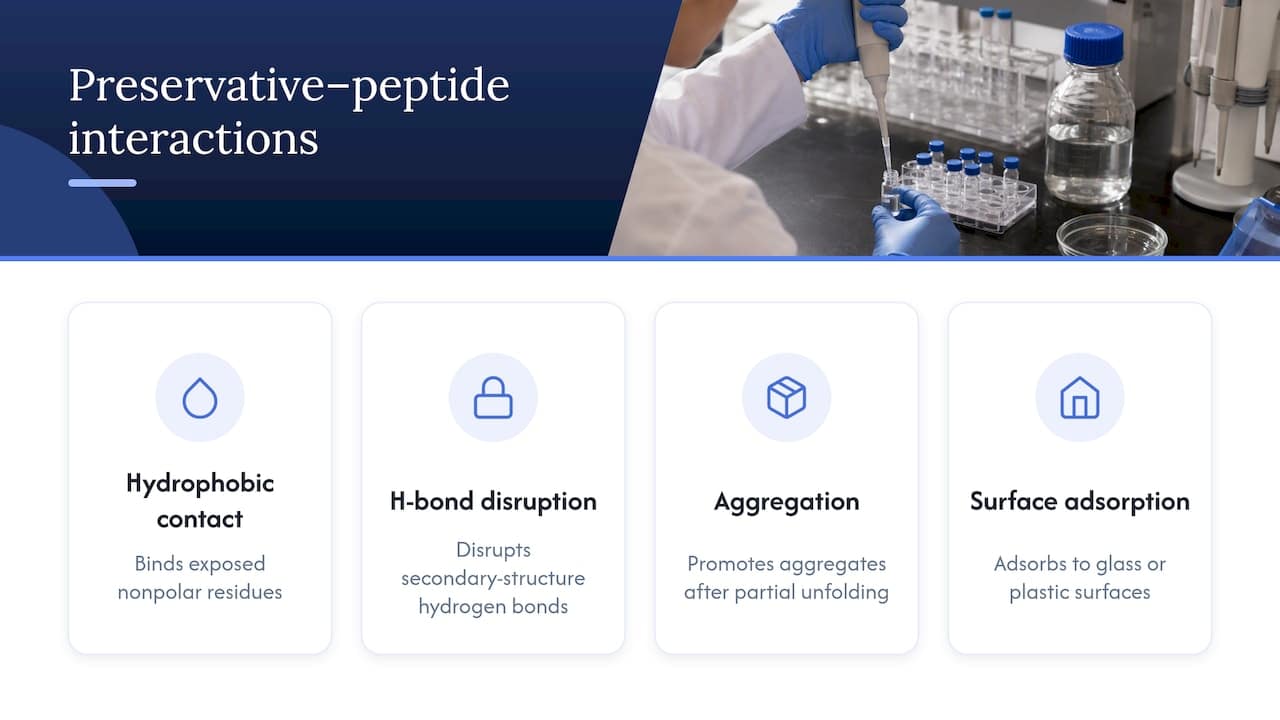
Preservatives interact with peptides through a handful of well-characterized mechanisms: hydrophobic contact with exposed nonpolar residues, disruption of the hydrogen bonds that hold secondary structure together, promotion of aggregation once a peptide partially unfolds, and simple adsorption to glass or plastic container surfaces. None of these require much preservative concentration to matter, and the effect is sequence-specific rather than universal.
Protein studies offer the clearest illustration. One line of work reported an aggregation risk order of m-cresol greater than phenol greater than benzyl alcohol greater than phenoxyethanol, while a separate study on a monoclonal antibody found the opposite pattern depending on the specific molecule, with benzyl alcohol forming particles in one case and phenoxyethanol showing better compatibility under the same test conditions. That inconsistency is the point: published rankings are a starting hypothesis, never a formulation rule.
One study found that model-protein reconstitution with bacteriostatic levels of benzyl alcohol produced copious insoluble aggregates within 24 hours, a result that should make anyone reconstituting a new peptide in bacteriostatic water run a visual and analytical check before relying on it for repeat use (source).
Preservative-dependent aggregation has been documented across multiple protein systems, with different preservatives producing different outcomes depending on the specific molecule tested.
Representative finding from preservative-protein compatibility research
Watch for practical red flags after reconstitution: visible turbidity appearing quickly, a rise in subvisible particle counts under light scattering, measurable potency loss on assay, or a sequence containing hydrophobic stretches likely to become exposed under stress. Any one of these should stop you from shipping or using that combination until it is resolved.
A stepwise workflow for selecting and validating a preservative
Treat preservative selection as an experimental decision, not a default setting copied from another product. The following sequence keeps the process defensible and auditable.
- Define the route and container first. Injectable use, topical use, glass vials and plastic containers each bring different extractables and adsorption behaviour, so the screen has to match the actual delivery format.
- Run a laboratory pre-screen. Use potency and integrity assays alongside dynamic or static light scattering to catch early aggregation, and include a forced-degradation step with each candidate preservative.
- Test antimicrobial effectiveness on the final dosage form, not on the preservative alone, using USP <51> or Ph. Eur. 5.1.3 methods, then move into real-time and accelerated stability studies plus an in-use simulation that mirrors repeated withdrawals.
- Apply a single decision rule: adopt the lowest preservative concentration that still passes antimicrobial effectiveness criteria without causing unacceptable peptide degradation.
Molecular-level evidence helps explain failures when they show up. Computational and NMR work on a model therapeutic peptide found that phenol made more frequent contact with hydrophobic regions and disrupted stabilizing hydrogen bonds compared with other preservatives tested, which is a useful diagnostic lens when a screen flags a problem but does not explain why.
Pro Tip: Set your acceptance thresholds for aggregation, potency loss, and particle counts before you start the screen, not after you see the data.
Reconstitution and storage practices that reduce risk
Good lab technique matters as much as the preservative choice itself. Aseptic reconstitution, a defined window for first use after mixing, and consistent syringe and needle hygiene on every withdrawal all reduce the chance of introducing contamination that a preservative then has to fight off.
- Reconstitute under aseptic conditions and record the time of first use for every preserved vial.
- Limit the number of repeated withdrawals from a single multidose vial and inspect for turbidity before each use.
- Store most peptide solutions refrigerated and protected from light, and monitor pH, since many acid-containing peptides are most stable in the 5–7 range.
- If turbidity, a colour change, or a potency drop appears, treat the vial as compromised and stop using it rather than troubleshooting in place.
Single-use sterile water remains the safer default for vulnerable research populations, for peptides with documented preservative incompatibility, or whenever testing shows a preservative measurably reduces potency. In those cases, the convenience of a multidose vial is not worth the stability trade-off.
Regulatory and safety checks before releasing a preserved product
Before a preserved peptide product goes anywhere near a researcher or a formulation line, a short documentation checklist closes most of the common gaps.
- Confirm the product’s classification in the relevant product monograph and database entry as bacteriostatic (multidose) versus sterile (single-use).
- Document antimicrobial effectiveness results using recognized pharmacopoeial methods, with acceptance criteria and stability data kept alongside the certificate of analysis.
- Check benzyl alcohol’s chemical safety classification and any route- or population-specific restrictions before finalizing a concentration.
- For topical or cosmetic peptide products, verify INCI labelling, check the Cosmetic Ingredient Hotlist, and never carry an injectable-grade preservative concentration over into a cosmetic formula without its own safety assessment.
How our resources support preservative selection and testing
A Peptide Compatibility Checklist is available for teams running this kind of screen, covering the stability and interaction risks worth checking before a preservative decision is locked in. Every peptide sold ships with a batch-specific certificate of analysis from third-party testing, providing a documented purity baseline to compare against once preservative exposure testing begins.
For the practical side of the workflow, a supplies catalogue carries bacteriostatic water, syringes, and other consumables for reconstitution and in-use testing, and our guide on bacteriostatic water for research covers the label and regulatory distinctions that matter before you reach for a multidose vial.
What the research actually tells us about preservative choice
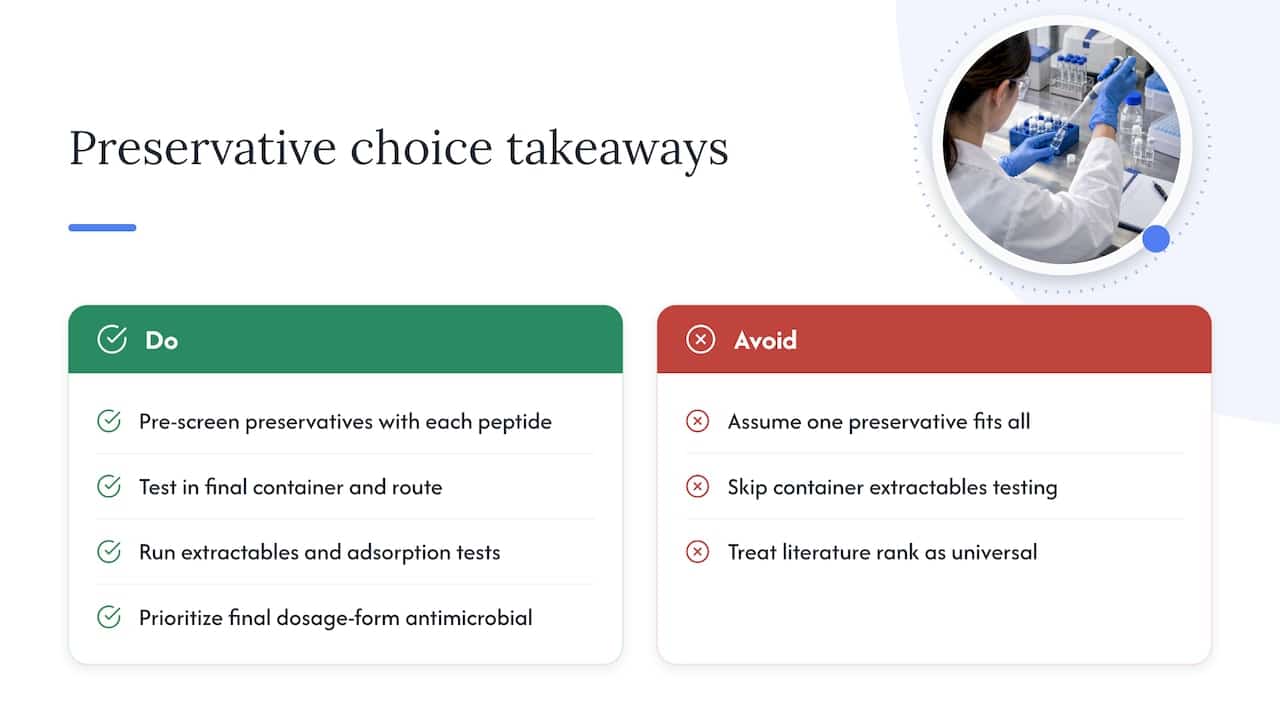
The honest takeaway from the compatibility literature is that “best preservative for peptides” is the wrong question. The data consistently show molecule-specific outcomes: a preservative that stabilizes one sequence can destabilize another with a similar structure, and published aggregation rankings flip depending on which protein or peptide was tested. Treating any preservative as a safe default is the single most common mistake in formulation planning, and it is an easy one to avoid with a short pre-screen.
What gets underrated is how much the container and route decision shapes everything downstream. Teams spend disproportionate effort debating preservative chemistry while skipping the extractables and adsorption testing that a glass versus plastic choice demands. If you can only prioritize one step from this entire workflow, make it the final dosage form antimicrobial test. A preservative that performs well on paper but fails on the actual formulation in its actual container has told you nothing useful.
— Admin
FAQ
What are the ingredients in peptides?
Peptides are composed of amino acids linked by peptide bonds, with the specific sequence and length determining the molecule’s structure and function. Formulated peptide products also contain excipients such as buffers, stabilizers, and sometimes preservatives like benzyl alcohol or phenoxyethanol, which are not part of the peptide itself.
What is the most effective preservative for cosmetics?
There is no single most effective preservative for cosmetics; effectiveness depends on the formulation’s pH, water content, and the specific active ingredients involved, including any peptides present. Phenoxyethanol is commonly used in topical peptide products for its relatively mild structural impact, but it still requires compatibility testing for each formula.
What are the uses of synthetic peptides?
Synthetic peptides are used in research settings for metabolic studies, recovery and healing research, and anti-aging or skin and hair care formulation work. They are also incorporated into cosmetic products such as serums and moisturizers where specific peptide sequences target particular skin functions.
What are peptides composed of?
Peptides are short chains of amino acids joined by peptide bonds, typically ranging from a few amino acids up to around 50 before they are generally classified as proteins. The sequence and folding of these amino acids determine how the peptide behaves, including how it interacts with preservatives or other formulation ingredients.
How do I know if a preservative is safe for my peptide?
You cannot assume safety from a preservative’s use in another product. A defensible answer comes only from running a compatibility pre-screen, antimicrobial effectiveness testing on your final dosage form using USP <51> or Ph. Eur. 5.1.3 methods, and stability testing specific to your sequence and container.
Sources
- Drug Product Database — Health Canada (bacteriostatic water / sterile water records)
- Antimicrobial preservatives induce aggregation of interferon alpha‑2a and related studies — PMC
- Prevention of benzyl alcohol‑induced aggregation of chymotrypsinogen by PEGylation — PubMed