

Purity tells you how much of a vial is the intended peptide, while potency measures that peptide’s biological activity. They come from different tests, so a high purity figure never guarantees high potency, and the reverse is also true. To judge quality, look for validated methods, traceable reference standards and a batch-specific certificate of analysis from an accredited lab.
TL;DR:
- An HPLC area percentage excludes water, salts, and residual solvents, so request a mass balance before treating it as content.
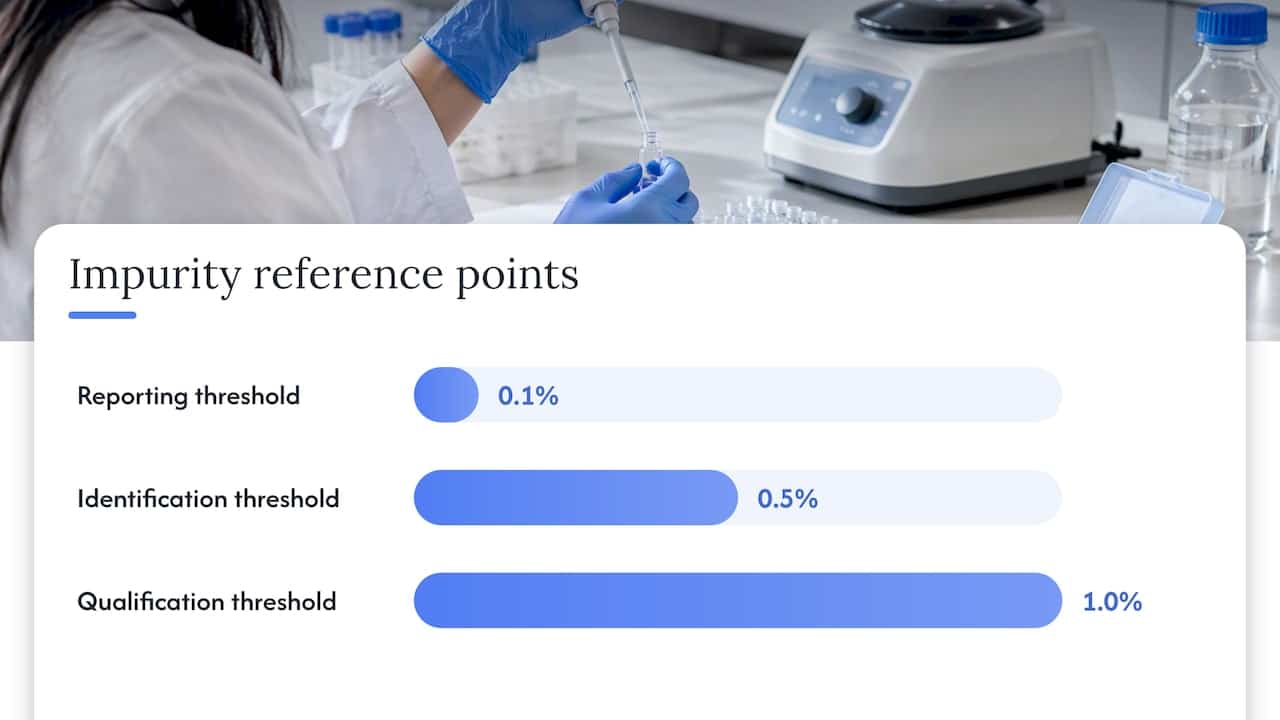
- Health Canada cites 0.1%, 0.5%, and 1.0% impurity thresholds for reporting, identification, and qualification, but dose and treatment duration can change their relevance.
- Before comparing lots or suppliers, verify the batch number, validated method, and traceable reference standard; an assay value reports peptide content, not biological activity.
- For dosing, use peptide content rather than vial weight, record the lot and assay method, and compare a new lot with the old before switching.
- Health Canada warns unauthorized injectable peptides may contain contaminants, and research use labeling does not make them lawful for human use in Canada.
Table of Contents
- What do purity, potency, assay and specific activity mean?
- How are purity and potency actually measured?
- Which thresholds and acceptance ranges should you expect?
- How do you read a peptide COA, step by step?
- Where do people misread purity and potency numbers?
- What does Health Canada say about peptides bought online?
- How do purity and potency affect reproducibility and data validity?
- How should you choose peptides for research versus cosmetic use?
- How do storage and handling change purity and potency over time?
- Do purity and potency affect stability in cosmetic formulations?
- How we verify purity and potency claims
- Where can you find third-party verified peptides?
- FAQ
- Sources
What do purity, potency, assay and specific activity mean?
Purity describes composition. It answers a chemical question: of everything in this sample, how much is the intended peptide, and how much is something else (truncated sequences, deletion products, counter-ions, water, residual solvents)? Relative purity is usually a chromatographic percentage. Absolute purity, often called peptide content, accounts for everything in the vial by mass, so it is almost always lower than the headline chromatographic figure.
Potency is a statement about function. It is the biological activity of the peptide, measured with a validated bioassay, while content (strength) is a physicochemical mass measurement. Specific activity, expressed as units of activity per milligram, links the two, and the results depend heavily on the method used.
The word “assay” causes confusion. In a chemistry setting, an assay is a quantitative test of how much active ingredient is present by mass. A bioassay is a separate test of what that ingredient does in a biological system. A COA that reports an assay value has told you about content, not about activity.
Think of it this way: purity and assay describe what is in the vial, and potency describes what it does. You need the right one for your question, and often both.
How are purity and potency actually measured?
Different questions need different instruments. Knowing which method sits behind a number is the fastest way to judge how far to trust it.
- Reversed-phase HPLC separates the peptide from related impurities and reports chromatographic purity as a peak area percentage.
- LC–MS adds mass identification, so impurities can be assigned to specific modifications such as oxidation, deamidation or deletion sequences. The ACS review cited above covers the challenges and pitfalls of this approach.
- Mass-balance purity starts at 100% and subtracts impurities, counter-ions, water and residual solvents to arrive at a content value.
- qHNMR and HiFSA sequencing provide independent identity and quantification. HiFSA 1D 1H NMR sequencing can establish identity and purity and complements LC–MS and HPLC, though several orthogonal methods are typically needed for full assurance.
- Validated bioassays measure activity where function matters. Because a bioassay depends on its cell system or readout, the same peptide can give different specific activity values across assays.
Method validation matters as much as the method itself. ICH validation guidance lists accuracy, precision, specificity, linearity and range as the characteristics to consider for assays and impurity tests, and it recommends well-characterized reference materials throughout validation. If a COA names a method but gives no sign that it was validated, you have a number without context.
For deeper technical background, our guide to peptide analytical techniques walks through each method in more detail.
Which thresholds and acceptance ranges should you expect?
Numbers on a COA only mean something against a benchmark. For impurities in synthetic peptides, Health Canada guidance aligned with Ph. Eur. practice describes a reporting threshold of 0.1%, an identification threshold of 0.5% and a qualification threshold of 1.0%. These can shift with dose and treatment duration, so treat them as reference points, not universal pass marks.
Assay and potency limits are conditional too. Health Canada’s quality guide for natural health products expects finished product specifications to cover identity, quantity, purity and potency with stated tolerance limits. Acceptance ranges are set per product and validated method, so a range that suits one assay may not suit another.
Reference standards anchor all of this. USP stresses that physical reference standards carry assigned values that are valid only with the specific validated methodology used to assign them. Our explainer on the peptide reference standard covers why that traceability matters when content values are reported.
How do you read a peptide COA, step by step?
A good COA is short, specific and traceable. Work through it in this order.
- Find the assay and the chromatographic purity. Note exactly what is reported (area percent, mass content, or both) and in what units.
- Inspect the impurity section. Look for specified impurities, total impurities, residual solvents, counter-ion content, water content and residue on ignition where listed.
- Confirm the methods. The COA should name the HPLC conditions, LC–MS identity confirmation, any qHNMR work and the bioassay if potency is claimed, plus the reference standard, the lab and the test date.
- Check traceability. The batch number on the COA must match the vial, and the document should be signed. Where you need more, ask for raw data or method SOPs.
Pro Tip: If a COA lists only HPLC area percent, ask for the relative response factor information or a mass-balance summary before treating the figure as content.
Our checklist on peptide supplier verification extends these steps to the supplier itself, and our guide to peptide batch consistency covers what good lab quality control looks like across lots.
Where do people misread purity and potency numbers?
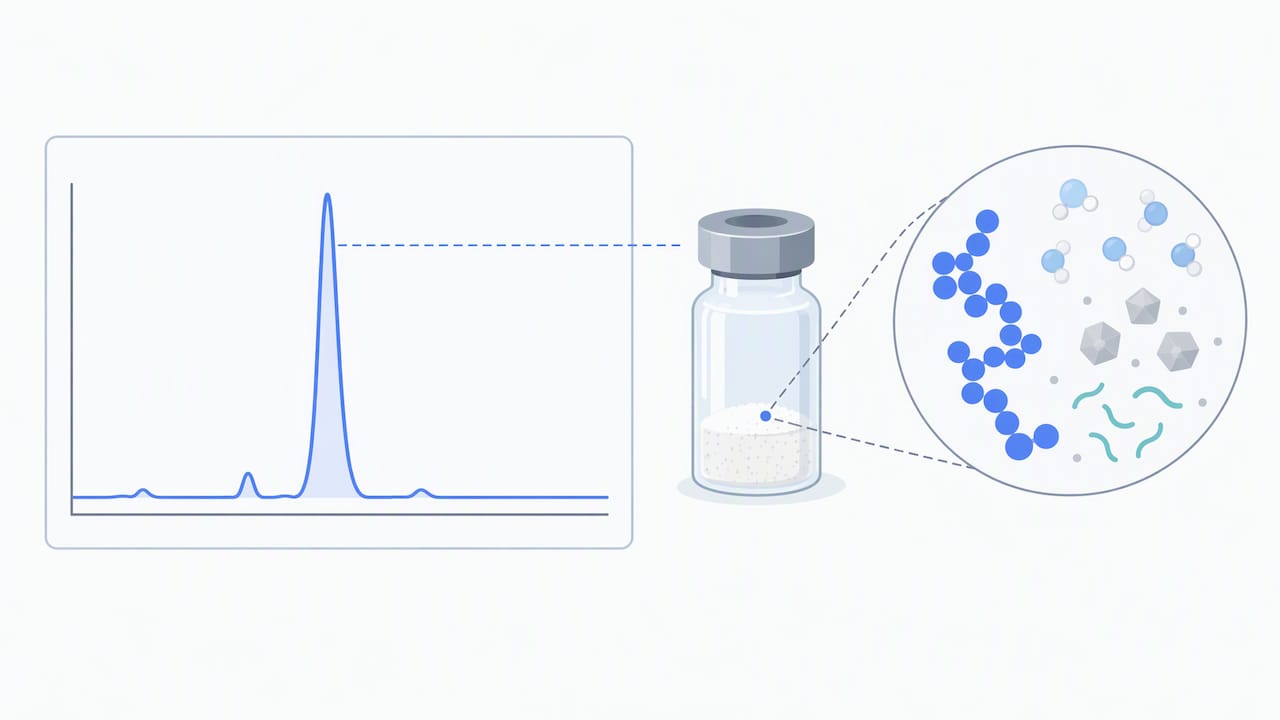
The most common mistake is treating chromatographic area percent as content. A peak that dominates the chromatogram says nothing about water, salts or solvents that the detector never saw, and it depends on how the chromatogram was integrated.
Response factors add a second trap. Using a relative response factor of 1 without determining it can lead to significant errors, and recent analytical work shows that a default value can overestimate or underestimate impurities, so peptide-specific values are needed for accurate impurity profiling.
A bare purity claim also leaves key questions open: which impurities were measured, by which method, against which standard, and whether potency was assessed at all. Because reference standard values are method-specific, comparing numbers from two labs that used different methods can mislead without adjustment.
When you compare suppliers, put method disclosure, validated assays and reference-standard traceability ahead of any marketing statement.
What does Health Canada say about peptides bought online?
Health Canada has warned that unauthorized injectable peptide drugs sold online can contain incorrect amounts, contaminants or unlisted ingredients, and can pose serious health risks. The same alert makes clear that labels such as “For Research Use Only” do not make these products lawful for human use in Canada.
In practice, that means three things. Use authorised channels for anything intended for human use. For research supplies, rely on batch COAs from accredited labs. And follow your institution’s own policies on sourcing and handling. A partner resource on why some peptides are sold for research use only gives further context on that labelling convention.
How do purity and potency affect reproducibility and data validity?
Every experiment assumes the dose you think you gave is the dose you gave. If the peptide content is lower than labelled, because the vial holds counter-ions and moisture, a nominal amount weighed out may deliver noticeably less active peptide. Two labs following the same protocol can then report different effect sizes, and neither is wrong about what they did. The material simply differs.
Impurities cause a different kind of damage. A truncated or oxidised variant may be inactive, but it may also bind the same target, compete with the intended peptide or trigger an unrelated response. That muddies dose-response curves and makes a negative result hard to interpret.
Potency adds a further layer. Two lots can match on purity and still differ in activity if folding, aggregation or modification changed after synthesis. Because bioassay results are method-dependent, reporting which assay and lot you used is part of making your work repeatable.
A few habits protect your data:
- Record the batch number and keep the COA with your lab notebook.
- Correct dosing for peptide content, not just vial weight.
- Run a new lot alongside the old one before switching mid-study.
- Report the supplier, lot and analytical method in your methods section.
How should you choose peptides for research versus cosmetic use?
Match the evidence on the COA to the job. For laboratory research, especially cell work, receptor assays or analytical standards, you need identity confirmation, a content value you can dose against and a full impurity profile. Where results hinge on activity, you also want a validated bioassay or a clear statement that potency was not assessed.
Cosmetic formulation weighs the evidence differently. The question is usually whether the ingredient is identified, whether its content is known well enough to hit a target concentration, and whether impurities could affect skin tolerance or formulation behaviour. Biological potency data is less commonly available for cosmetic peptides, so efficacy is normally judged through finished-product testing. Our guide to cosmetic peptide efficacy testing methods covers that side, and our article on sourcing cosmetic-grade peptides explains what to ask suppliers.
A simple rule of thumb: the more your result depends on exact concentration, the more you need content and impurity data. The more it depends on biological response, the more you need a validated potency method. Whichever applies, confirm the batch COA matches the lot you received.
How do storage and handling change purity and potency over time?
A COA describes a vial on the day it was tested. Storage decides what you actually use months later. Peptides can degrade through oxidation, deamidation, hydrolysis and aggregation, and starting materials, manufacturing and storage can all introduce modifications, which is why a risk-based impurity control strategy is recommended.
Practical habits slow that drift:
- Keep lyophilised powder sealed, cold and protected from light and moisture.
- Let a vial reach room temperature before opening so condensation does not enter.
- Reconstitute only what you need, and aliquot the rest to avoid repeated freeze-thaw cycles.
- Use the diluent and pH your protocol specifies, since some sequences are far less stable in solution.
- Label every aliquot with lot number and preparation date.
Watch for physical cues such as cloudiness, particles or colour change, but remember that degradation is often invisible. If a result looks off, re-testing an aged aliquot against a fresh vial is a quick sanity check. Because a purity or potency value can change after reconstitution, treat a COA as a baseline, not a guarantee for the life of the vial.
Do purity and potency affect stability in cosmetic formulations?
In a finished serum or cream, the peptide shares space with water, preservatives, acids, oils and sometimes metal ions. Residual impurities from synthesis can interact with those ingredients, and degradation products can change appearance, odour or pH over time. A cleaner starting material gives the formulator fewer unknowns to troubleshoot.

Content accuracy matters just as much. If the supplied peptide content differs from what the label implies, the finished product may carry less active ingredient than designed, even though the formula looks correct on paper. That is why formulators use a content value, not just vial weight, when calculating inclusion levels.
Potency of the raw peptide does not map neatly onto performance in the jar. A peptide can be fully active at the bench and still lose function in a formulation that is too acidic, too warm or exposed to oxidising ingredients. This is why finished-product stability work is separate from raw-material testing. Our lab-ready workflow for testing peptide cosmetic product stability outlines how to check this, and our Canadian label guide to anti-aging peptide ingredients helps you read ingredient names on finished products.
How we verify purity and potency claims
We believe a purity claim is only as good as the paperwork behind it. Our practice is to offer batch-specific COAs and third-party testing. For lot-specific questions, contact us. When you need reliable, research-grade material, we want you to be able to check our work.
— Admin
Where can you find third-party verified peptides?
We offer research-grade and cosmetic peptides with batch-specific COAs and Canadian fulfilment, so the documentation described above comes with your order.

- Browse our research and cosmetic peptides with documentation options
- Pair them with lab essentials from our supplies range
This article is general information, not a substitute for advice from a qualified doctor. Consult a qualified healthcare professional about your own circumstances before acting on anything here.
FAQ
What purity do peptides need to be?
It depends on the application. Analytical standards and sensitive assays call for higher purity with a full impurity profile, while screening work can tolerate less. For synthetic peptides, Health Canada guidance describes impurity reporting, identification and qualification thresholds of 0.1%, 0.5% and 1.0%.
What is the difference between purity, potency and assay?
Purity describes how much of a sample is the intended peptide versus impurities. Assay is a quantitative test of content by mass, and potency is biological activity measured by a validated bioassay. Specific activity links mass to activity.
How do I calculate the pI of a peptide?
The isoelectric point is the pH at which the peptide carries no net charge. Estimate it from the pKa values of the N-terminus, C-terminus and ionisable side chains, or use a standard pI calculator. It is a theoretical value, so confirm it experimentally if your work depends on it.
What is the difference between synthetic peptides and regular peptides?
Synthetic peptides are made by chemical synthesis in a lab, while natural peptides are produced by living systems. Synthesis can leave related impurities such as deletion sequences, which is why impurity profiling and control matter for synthetic material.
Sources
- [Characterization of Synthetic Peptide Therapeutics
Using Liquid Chromatography–Mass Spectrometry: Challenges,
Solutions, Pitfalls, and Future Perspectives | Journal of the American Society for Mass Spectrometry | ACS Publications](https://pubs.acs.org/jamsef/article/32/8/1852/595328/Characterization-of-Synthetic-Peptide-Therapeutics) - Think twice before injecting peptides bought online: unauthorized products can seriously harm you – Canada.ca
- Health Care Products, Health Protection, Drugs