

The gauge you pick comes down to three things: how thick the liquid is, how much of it you are moving, and what the needle has to pierce. For most aqueous lab work, a needle in the 18 to 23 gauge range is a sensible starting point. Finer needles (25 to 30 gauge) suit small volumes and delicate, low-viscosity work. Thicker fluids need a lower gauge number. Barrel size is a separate decision, and it matters just as much for accuracy.
This guide is written for researchers, formulators and lab staff who buy and handle syringes. It covers how gauge numbering works, how to match gauge to the task, and where gauge and barrel size interact. It does not give dosing or injection advice for people. Clinical needle choice is a decision for a qualified health professional.
TL;DR
- A higher gauge number means a thinner needle. A lower number means a wider bore and faster flow.
- Match gauge to fluid viscosity, volume and the material you pierce (a vial stopper, tissue, a septum). Do not match it to habit.
- Barrel size drives accuracy. Use the smallest syringe that holds your volume, because its markings are spaced further apart and are easier to read.
- Gauge and length are separate specifications. Check both before every order.
- Everything we say here is for laboratory and research contexts. Clinical needle selection belongs to health professionals.
Table of Contents
- How gauge numbering works
- Match the gauge to the fluid
- Match the gauge to what the needle has to pierce
- Why the clinical guidance is still useful to a researcher
- Barrel size matters as much as gauge
- Perspective: how we think about syringe selection
- A step-by-step way to choose
- Common mistakes
- Syringes and supplies from Peptilab
- Quick reference by task
- FAQ
- Sources
How gauge numbering works
Gauge is an inverse scale. The bigger the number, the smaller the outer diameter. That feels backwards at first, and it is the single most common source of ordering mistakes. A 30G needle is much finer than an 18G one.
The table below uses a standard gauge reference published by a university lab. It lists outer and inner diameters in millimetres. Note that inner diameter, not outer, controls how easily fluid passes through.
| Gauge | Outer diameter (mm) | Inner diameter (mm) | Typical lab feel |
|---|---|---|---|
| 18 | 1.270 | 0.838 | Wide bore, fast transfer, thicker liquids |
| 21 | 0.8192 | 0.514 | General purpose, good balance |
| 22 | 0.7176 | 0.413 | General purpose |
| 23 | 0.6414 | 0.337 | General purpose, slightly finer |
| 25 | 0.5144 | 0.260 | Fine, low-viscosity liquids |
| 27 | 0.4128 | 0.210 | Fine, small volumes |
| 29 | 0.3366 | 0.184 | Very fine |
| 30 | 0.3112 | 0.159 | Very fine, slow flow |
| 31 | 0.2604 | 0.133 | Finest of the common sizes |
Values come from the needle gauge table published by the Caltech Leech lab. Wall thickness varies by manufacturer and needle type (regular, thin-wall, extra-thin-wall), so inner diameters can differ slightly between brands. Check the spec sheet of the product you are buying.
Gauge is not length
A needle spec has at least two numbers: gauge and length, usually in inches or millimetres. A 25G needle at 5/8 inch behaves very differently from a 25G at 1.5 inches. Longer needles add resistance, so flow slows even at the same gauge. If a protocol says only “25G”, ask what length it assumes.
Match the gauge to the fluid
Viscosity is the first filter. Water-like solutions pass through almost any gauge. Oils, suspensions and gels do not.
The Public Health Agency of Canada’s needle selection guidance notes that a larger bore, meaning a smaller gauge number such as 22G, is needed for thicker products so they flow properly. That is a clinical document, but the physics is the same on the bench: thick liquid plus a narrow needle means high back-pressure, slow transfer and a higher chance of the plunger slipping or the needle popping off.
A practical way to think about it:
- Thin aqueous solutions (buffers, saline, reconstituted lyophilised powders, bacteriostatic water): 23G to 27G is workable, and finer if the volume is small.
- Moderately viscous solutions (glycerol blends, some formulation bases): 18G to 22G.
- Oils and suspensions: the lower end of the range, then test. Warming a sample slightly, where your protocol allows it, can also reduce viscosity.
- Drawing up from a vial: many labs draw up with a wider needle and swap to a finer one for dispensing. Wide needles fill faster and cause less foaming.
The top-ranking guides for this topic say much the same: lab work typically sits in the 18 to 23 gauge range, with specialised needles for unusual cases. Treat that as a starting range, not a rule.
Match the gauge to what the needle has to pierce
The second filter is the material in the way.
Vial stoppers and septa
Rubber stoppers are repeatedly punctured in reconstitution and sampling work. A finer needle makes a smaller hole and generally causes less coring, where a plug of rubber is cut out and drops into the solution. Many labs use 21G to 25G for stopper work. Insert at the same point and angle each time, and avoid dragging the needle sideways.

Biological tissue and animal work
Animal research is tightly governed by institutional protocols, and the gauge is usually specified there. Gavage needles are a good example: the gauge is matched to body weight. Queen’s University’s animal care procedure ranges from 24G for mice under 14 g up to 16G for rats over 200 g to protect the oesophagus. If your protocol and a generic chart disagree, the approved protocol wins.
Intradermal and shallow work
For shallow placement, fine needles and small syringes are the standard. A clinical training text describes intradermal technique with a tuberculin syringe and a 26 or 27 gauge needle, with volumes usually under 0.5 mL. The takeaway for a lab reader is the pairing: very small volumes call for a fine needle and a graduated small-barrel syringe together.
Why the clinical guidance is still useful to a researcher
Canadian clinical references are some of the clearest public material on gauge and length, even though they address vaccination and not bench work. The Canadian Immunization Guide says the right needle is chosen so the product reaches the intended tissue layer, and that a poor choice raises the risk of local reactions. The same page recommends a 1 mL or 3 mL syringe depending on dose volume. The Public Health Agency of Canada’s reference ranges are 22 to 25 gauge for intramuscular, 25 gauge for subcutaneous and 26 to 27 gauge for intradermal administration. They are published for immunization. Do not carry them into other uses.
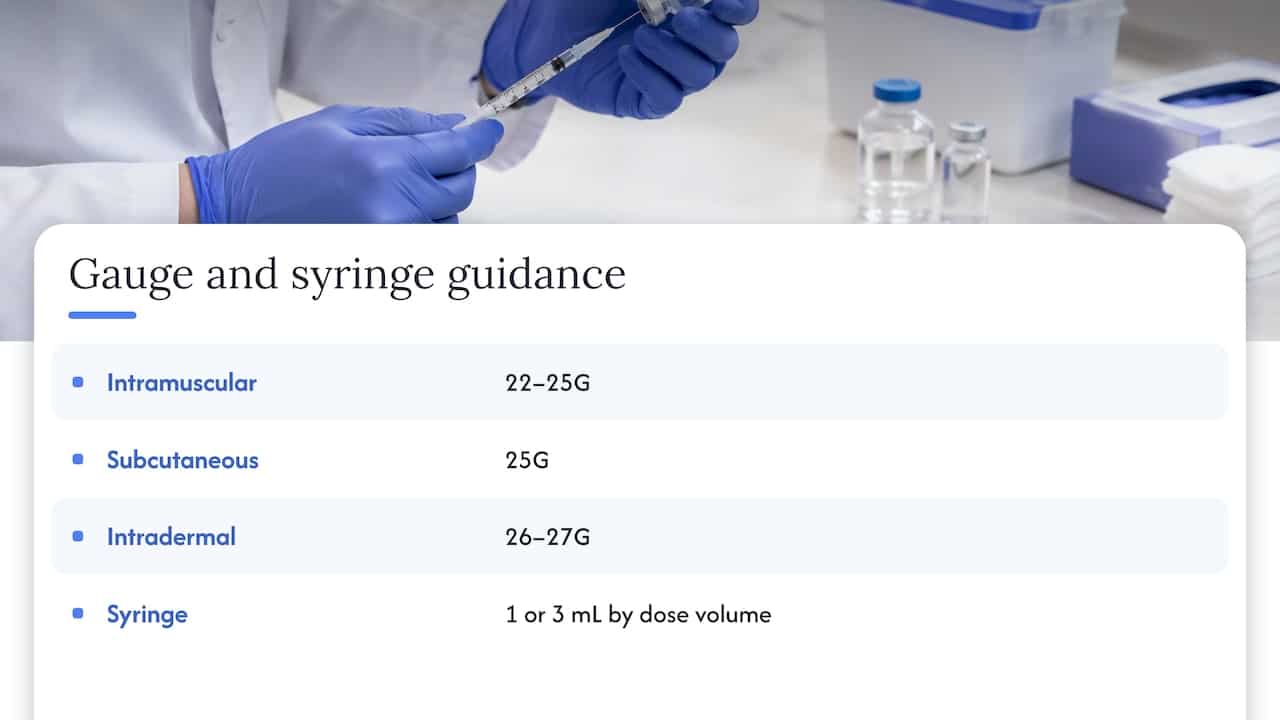
The principle transfers well: define the target, then pick gauge and length to reach it. Don’t pick the needle first.
Barrel size matters as much as gauge
Many accuracy problems blamed on gauge are really barrel problems. Syringe markings are spaced across the barrel, so a larger barrel packs more volume into each millimetre of scale. A small volume read off a large barrel is a coarse measurement.
HealthLink BC’s guidance on insulin syringes makes the point clearly. Standard sizes are 0.25 mL, 0.33 mL, 0.5 mL and 1 mL, and the advice is to use the smallest syringe that holds the dose, because the markings are easier to read. Once again it is a clinical page, but the logic applies to any small-volume measurement.
| Volume you need to measure | Sensible barrel | Why |
|---|---|---|
| Under 0.25 mL | 0.3 mL or 0.5 mL | Widest marking spacing |
| 0.25 to 0.5 mL | 0.5 mL or 1 mL | Good resolution, enough headroom |
| 0.5 to 1 mL | 1 mL (often called 1 cc) | Standard for small-volume work |
| 1 to 3 mL | 3 mL | Fewer refills, adequate marking |
Note that 1 mL and 1 cc are the same volume. Product listings use both, and the ordering mistake to avoid is confusing a unit-marked insulin-style syringe (100 units per mL) with one graduated in millilitres. Check the scale printed on the barrel before you do any arithmetic.
Dead space
The fluid left in the hub and needle after the plunger is fully depressed is dead space. It matters when you work with expensive or scarce material. Low dead space designs reduce loss. If you are drawing small aliquots of costly compounds, look for this feature on the spec sheet.
Perspective: how we think about syringe selection
We supply research-grade and cosmetic peptides, plus the lab essentials that go with them: syringes, alcohol wipes and bacteriostatic water. Every batch of what we sell is third-party tested and comes with a certificate of analysis, and our customers are researchers, laboratories and formulators.
From that vantage point, we see the same pattern. Teams spend weeks qualifying a compound and then pick a syringe in thirty seconds. That is backwards. A pure, well-characterised material measured with a coarse barrel gives you noisy data, and noisy data wastes the quality you paid for.
Our advice is simple:
- Write the volume range of your protocol first.
- Choose the smallest barrel that covers it.
- Choose the gauge for the fluid and the surface you pierce, not for habit.
- Record gauge, length and barrel size in your lab notes so the setup can be repeated.
We also say plainly that our products are for scientific, cosmetic and laboratory research. They are not for personal use and nothing here is medical advice.
— Admin
A step-by-step way to choose
- Define the task. Reconstituting a powder, sampling, transferring, dispensing small aliquots, or working inside an approved animal protocol?
- Define the volume range. Note your smallest and largest volumes. The smallest sets the barrel size.
- Check viscosity. Aqueous solutions allow a finer needle. Oils and suspensions need a lower gauge number.
- Check the barrier. Rubber stopper, septum, film or tissue? Finer needles reduce coring, but too fine a needle on a thick sample stalls.
- Choose length. Pick the shortest length that reaches the target. Extra length adds resistance and dead space.
- Test with a blank. Run the setup with water or buffer first. You will see flow, foaming and readability problems before they cost you sample.
- Document it. Gauge, length, barrel size, brand and lot number go in the record.
Common mistakes
- Reading the number backwards. A 30G is finer than an 18G. Double-check before ordering in bulk.
- Using one needle for everything. A wide needle for drawing up and a fine one for dispensing is often the better workflow.
- Oversized barrels. A 3 mL syringe for a 0.1 mL aliquot is a recipe for error.
- Reusing needles. A needle dulls with every stopper puncture. A blunt tip tears rubber and increases coring, and it also raises cross-contamination risk. Use a fresh needle for each use unless your SOP says otherwise.
- Ignoring the Luer connection. Luer lock needles screw on and resist popping off under pressure, which helps with viscous samples. Slip-tip needles push on and are faster to swap.
- Skipping sharps handling. Used needles go straight into a rigid, puncture-resistant sharps container. Follow your institution’s biosafety rules and your municipality’s disposal requirements.
Syringes and supplies from Peptilab
If you are setting up a bench workflow for peptide research, our Supplies category lists the syringes, alcohol wipes and bacteriostatic water we carry, all shipped from within Canada so you avoid import delays. A common starting point for small-volume work is our 1 cc (1 mL) syringes. You can browse our full research peptide catalogue or the shop to see everything in one place. Supplies are sold for laboratory use only.
Quick reference by task
| Task | Starting gauge range | Barrel guidance | Notes |
|---|---|---|---|
| Reconstituting lyophilised powder | 21G to 25G | Match to diluent volume | Add diluent slowly down the vial wall to limit foaming |
| Drawing up from a vial | 18G to 23G | Smallest barrel that holds the volume | Swap to a finer needle for dispensing if needed |
| Small aliquots (under 0.5 mL) | 25G to 30G | 0.3 to 1 mL | Check dead space |
| Viscous formulations | 18G to 22G | 1 to 3 mL | Test flow with a blank first |
| Approved animal work | Per protocol | Per protocol | Follow your ethics approval, such as gavage by body weight |
These are starting points drawn from general lab practice and the references above, not guarantees. Your SOP, your supplier’s spec sheet and your institution’s safety office always take priority.
FAQ
Which is smaller, a 20 or a 22 gauge needle?
The 22 gauge is smaller. Gauge runs inverse to diameter, so a higher number means a thinner needle. By the standard table, a 20G has an outer diameter of about 0.908 mm and a 22G about 0.718 mm.
What gauge is best for lab work in general?
For general aqueous transfers, the 18 to 23 gauge range is the usual starting point. Go finer (25G to 30G) for very small volumes and low-viscosity liquids. Go lower in number for oils or suspensions. Confirm against your protocol.
Does a bigger syringe or a thinner needle give better accuracy?
Barrel size has more effect on measurement accuracy than gauge does. A smaller barrel spaces its markings further apart, which makes small volumes easier to read. Gauge mainly affects flow, comfort of use and what the needle can pierce.
Can I use the clinical gauge charts for research work?
Use them as a reference for principles only. Canadian clinical charts, such as those in the Canadian Immunization Guide, are written for vaccination in people. For animal work follow your approved protocol, and for anything involving people ask a qualified health professional.
Is 1 cc the same as 1 mL?
Yes. One cubic centimetre equals one millilitre. Product listings use both terms, so check whether the barrel is marked in millilitres or in units before you calculate volumes.
Sources
- Syringe needle gauge table, Caltech Leech lab
- Vaccine administration: a guide to selecting needle gauge and length, Public Health Agency of Canada
- Vaccine administration practices, Canadian Immunization Guide
- Gavage techniques in small animals, Queen’s University Animals in Science
- 7.3 Intradermal injections, Clinical Procedures for Safer Patient Care
- Insulin syringes, HealthLink BC