

White label skincare lets you launch a branded product fast by using an established formula, which makes it a sound route when your goal is to test a single, narrow product concept rather than build a formula from scratch. The immediate next step is to define one specific use case and request full INCI documentation and compliance records from suppliers before you commit to anything.
TL;DR:
- White label uses an unmodified formula that other brands may share; private label permits limited changes, while custom formulation gives you ingredient control and ownership.
- Health Canada requires a Cosmetic Notification Form within 10 days of the first sale, and its ingredient entries must match the bilingual label exactly.
- Before ordering samples, request INCI concentrations, batch specific certificates of analysis, change control and recall procedures, manufacturing site details, minimum quantities, and written lead times.
- Test samples in intended packaging, set pass or fail criteria, and complete stability and compatibility checks before selling a controlled pilot batch.
Table of Contents
- What white label, private label and custom formulation actually mean
- Benefits and trade-offs of white label skincare
- How long does a white label skincare launch actually take?
- Step-by-step launch checklist from concept to controlled first sale
- Supplier due diligence: documents and questions for your first call
- Labelling and Health Canada essentials to plan before you launch
- What lab-grade documentation should actually look like
- Should you validate with white label before building a custom formula?
- How PeptiLab supports peptide-based white label projects
- FAQ
What white label, private label and custom formulation actually mean
These three terms get used interchangeably, but they describe different levels of control and cost. White label means you choose an existing, unmodified formula from a supplier’s catalogue and apply your own branding and packaging. Multiple brands can sell the identical formula under different names, so your differentiation comes entirely from positioning, packaging and marketing.
Private label typically allows some adjustment: a different fragrance, a tweak to a concentration, a custom colour, while the base formula stays largely the supplier’s own. Custom formulation means a supplier (or an independent lab) builds a product from scratch to your specifications, including ingredient selection and testing, which costs more and takes longer but gives you full ownership of the formula.
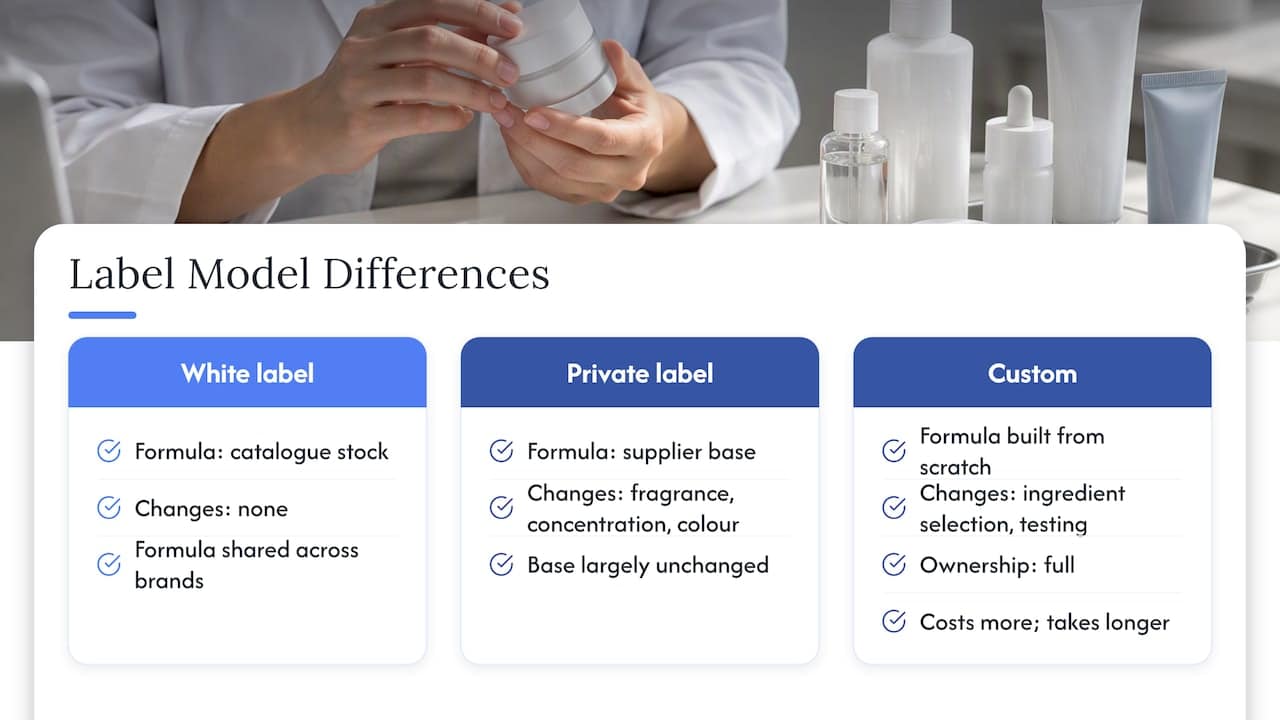
When you talk to suppliers, ask directly which category their programme falls into. A supplier who advertises “custom skincare solutions” may really mean minor tweaks to a stock base. Get the actual scope in writing: what you can change, what stays fixed, and whether the formula is exclusive to you or shared across other clients.
Benefits and trade-offs of white label skincare
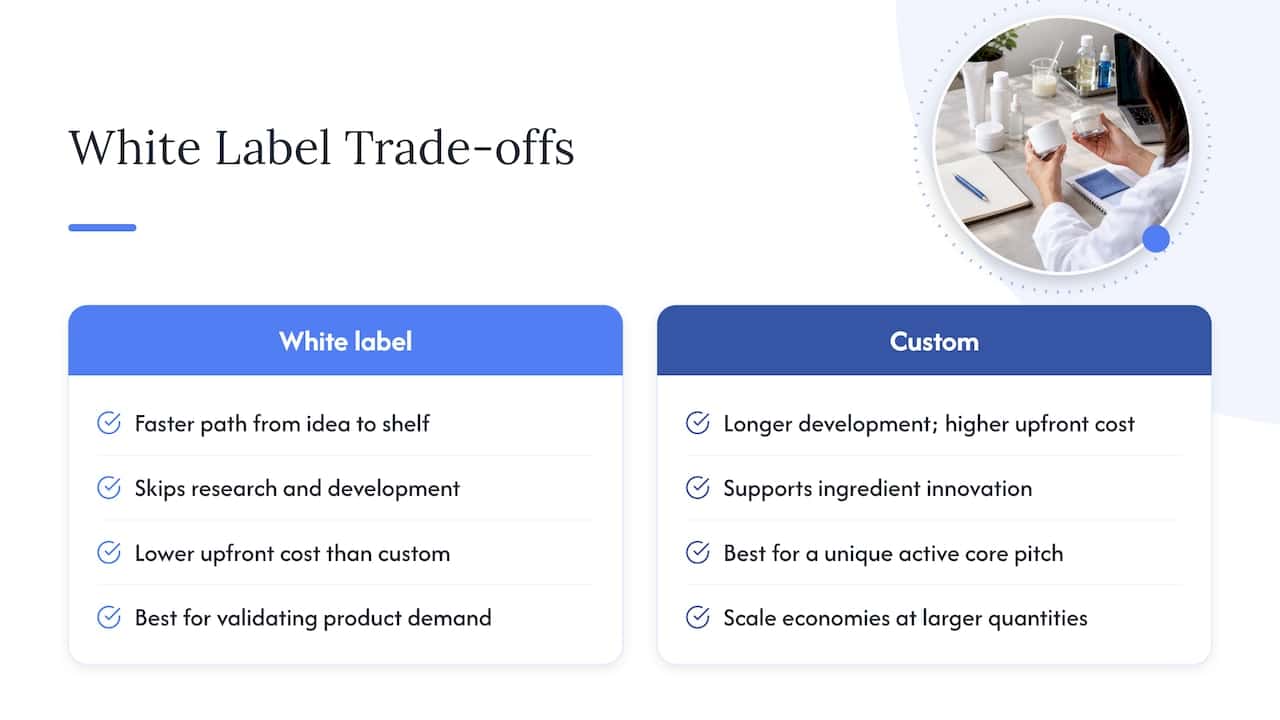
White label is attractive because it compresses the path from idea to shelf. You skip the research and development cycle, work with formulas that already have a track record, and typically pay less upfront than a custom build requires.
The trade-off is differentiation. Because the formula isn’t unique to you, your brand competes on packaging, story and price rather than ingredient innovation, and per-unit costs can run higher at low order volumes compared to the economies of scale a custom manufacturer might offer at larger quantities. You’re also dependent on your supplier’s documentation and quality systems: if their paperwork is incomplete, your Cosmetic Notification Form filing and your label accuracy both suffer.
Practically, white label suits a founder validating demand for a specific product, such as a single peptide serum or a targeted moisturizer, before investing in a proprietary line. If your business depends on a unique active or mechanism as its core pitch, custom formulation is the better fit from day one.
How long does a white label skincare launch actually take?
Expect the full sequence from sampling to a controlled first sale to run several weeks to a few months, depending on how quickly you make decisions and how backed up your supplier’s pilot queue is. Sampling and formula selection usually move fastest since you’re choosing from existing options rather than waiting on development work.
Artwork and label finalization take longer than most first-time founders expect, mainly because label text has to match your Cosmetic Notification Form inputs exactly, ingredient by ingredient. Build in time for a review pass before anything goes to print.
Pilot runs and stability or compatibility testing add further weeks, and this is where rushing causes the most expensive mistakes. Minimum order quantities and packaging choices also shift timelines: custom closures or printed cartons routinely add lead time that stock packaging avoids. Treat your first order as a pilot, not a full launch, regardless of how confident you feel.
Step-by-step launch checklist from concept to controlled first sale
Following the steps in order prevents the two most common failures: label and CNF mismatches, and products going to market before compatibility testing is done. Health Canada’s guidance on cosmetic notifications frames this as a sequence that minimizes rework when followed in order, and the checklist below reflects that sequence.
- Define your target customer and a single product use case. Pick one problem (hydration, brightening, a specific peptide benefit) before you contact a single supplier; a broad brief invites mismatched quotes and wasted samples.
- Shortlist formulas and request full documentation. Ask for complete INCI lists, ingredient concentration ranges, certificates of analysis, manufacturing site details, minimum order quantities and lead times, all before you commit to a sample order.
- Order and test samples. Check the formula against your intended packaging for compatibility, and get honest feedback on texture, scent and performance from people outside your own team.
- Finalize bilingual artwork against your CNF inputs. Every ingredient name, concentration and claim on the label has to match what you’ll submit on the notification form; reconciling them now avoids a rejected or delayed filing later.
- Run stability and compatibility testing, and set acceptance criteria. Small-batch quality assurance, including a basic preservative challenge check, catches problems before they reach a customer, and documented acceptance criteria turn gut feel into a real pass/fail standard.
- Submit the Cosmetic Notification Form and keep your dossier complete. Health Canada expects the CNF within a set window after your first sale, and a complete dossier of supplier documentation prevents the delays that come from common CNF submission errors like mismatched ingredient names or missing concentrations.
- Run a controlled pilot sale with batch traceability. Track which batch went to which customer, watch for any adverse reaction reports, and only scale production once your acceptance criteria have been met consistently across the pilot.
Pro Tip: Treat every supplier promise as a line item on a written deliverables checklist rather than a verbal assurance: if it isn’t documented, assume it won’t happen on schedule.
Supplier due diligence: documents and questions for your first call
A supplier call should produce paperwork, not just reassurance. Ask for these items before you place even a sample order:
- Full INCI list with exact concentrations or defined concentration range codes for each ingredient.
- Certificates of analysis tied to specific batches, not generic product sheets.
- Batch-release records and a written change-control policy describing how they notify you of formula or supplier changes.
- Sanitary and quality certifications for the manufacturing site itself.
- A documented complaint and recall procedure, including expected response times.
- Minimum order quantities, pilot-run options, fill-and-finish capabilities, packaging specifications and the full artwork approval process.
- Pricing tiers by volume and realistic lead times for each stage, from sample to reorder.
Turnkey supplier claims vary widely: some suppliers coordinate formulation, packaging and regulatory review as one package, while others only hand you a formula and leave the rest to you. Converting every verbal promise into a written deliverables checklist with explicit acceptance criteria is the single best protection against scope surprises after you’ve paid a deposit.
Pro Tip: Ask for a sample certificate of analysis before you order anything: if a supplier hesitates to share one, treat that as a decision point, not a detail to follow up on later.
Labelling and Health Canada essentials to plan before you launch
Your label and your Cosmetic Notification Form have to agree with each other down to the ingredient name, so plan both at the same time rather than treating the CNF as an afterthought.
Core CNF requirements include product identity, a full INCI ingredient list with concentrations or concentration range codes, dealer and manufacturer contact information, the product’s use category and form, and relevant directions or warnings, according to Health Canada’s guide for cosmetic notifications.
On the label itself, Health Canada’s labelling requirements call for:
- Bilingual text for all mandatory elements, including product identity, net quantity and directions.
- Metric net quantity, a dealer name and principal place of business, and consumer contact information.
- A complete INCI-format ingredient list rather than marketing-friendly ingredient names.
- Individual disclosure of certain fragrance allergens once they exceed set thresholds, rather than folding them into a generic “parfum” listing.
The CNF itself is filed after your first sale, but your supplier dossier needs to be complete before that first sale happens: scrambling to track down a missing concentration figure after product is already on shelves is how filings get delayed. Our guidance on filing within the 10-day window walks through this reconciliation step in more detail.
What lab-grade documentation should actually look like
Treating documentation as a formality rather than a safeguard is where many first-time brand owners get caught out. From a peptide and cosmetic ingredient supply standpoint, the documentation that actually reduces launch risk looks like this:
- Third-party certificates of analysis for key active ingredients, tied to the specific batch you’re buying rather than a generic spec sheet.
- Full INCI transparency with concentration ranges precise enough to complete your CNF ingredient entries without guesswork.
- Compatibility and preservative challenge testing results for any small batch before it goes to a pilot customer.
- Batch traceability records and a documented complaint log, so a single adverse report can be traced back to a specific production run.
We supply cosmetic peptides with batch-specific certificates of analysis and Canadian fulfillment, which is the kind of documentation trail a CNF filing and a cautious retailer will both ask to see.
Should you validate with white label before building a custom formula?
White label earns its place as a validation tool: it lets you confirm there’s real demand for a product concept before you spend on proprietary development. Once a product is selling consistently and you can point to a specific ingredient or mechanism as your real differentiator, that’s the signal to move toward private or custom formulation, where you control the formula outright. Rushing straight to custom development without that validation step is the more common and more expensive mistake.
— Admin
How PeptiLab supports peptide-based white label projects
If your white label concept centres on a peptide active, sourcing is often the hardest part to get right. We offer cosmetic peptides with certificates of analysis and small-batch supplies such as syringes and bacteriostatic water, manufactured and fulfilled domestically to reduce import delays.

Specifically, we can help with the sourcing and documentation side of your launch: identifying a peptide active suited to your use case, providing the COA and concentration data your CNF filing needs, and supplying the small-batch materials for your compatibility testing. Start by browsing our research and cosmetic peptide catalogue to see what’s available for your pilot batch.
FAQ
What’s the difference between white label and private label skincare?
White label means you apply your branding to an existing, unmodified formula shared across multiple brands. Private label usually allows some customization, like fragrance or concentration tweaks, while the base formula still belongs largely to the supplier.
How long does it take to launch a white label skincare product?
Timelines vary with supplier pilot queues and packaging choices, but expect sampling, artwork finalization, compatibility testing and a controlled pilot run to together take several weeks to a few months. Custom packaging and printed cartons typically extend that timeline further.
Do I need to file a Cosmetic Notification Form for a white label product?
Yes, Health Canada requires a Cosmetic Notification Form after your first sale regardless of whether the formula is white label, private label or custom, and it must include your ingredient list, concentrations and manufacturer contact details. Your label and CNF entries need to match exactly to avoid processing delays.
What documents should I request from a white label skincare supplier?
Ask for a full INCI list with concentrations or concentration ranges, batch-specific certificates of analysis, batch-release records, a change-control policy and a documented complaint and recall procedure. Treat verbal assurances as incomplete until they appear in writing.
Can white label skincare include peptide ingredients?
Yes, white label programs commonly include peptide-based serums and moisturizers, and the same documentation standards apply: you’ll need full INCI transparency and concentration data for your CNF filing. We supply cosmetic-grade peptides with certificates of analysis suited to this kind of formulation work.