
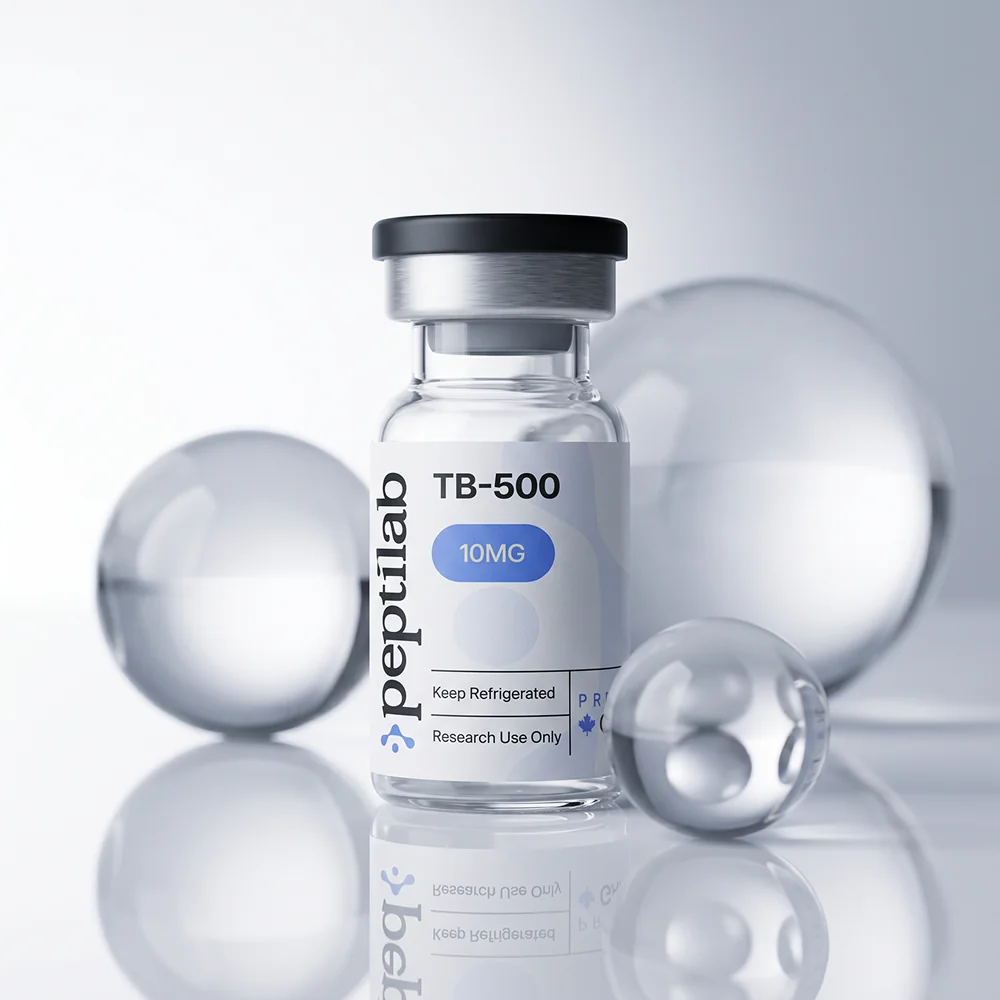
TB-500 is a synthetic version of a naturally occurring peptide fragment derived from Thymosin Beta-4 (Tβ4), a protein present in virtually all human and animal cells. The research interest in TB-500 has grown considerably over the past two decades, with published studies examining its role in actin regulation, angiogenesis, cell migration, and inflammatory modulation in laboratory models.
This article provides a research-focused overview of TB-500 for scientists and laboratory professionals.
Background: Thymosin Beta-4 and Its Derivatives
Thymosin Beta-4 is a 43-amino acid peptide that was first isolated from calf thymus tissue. It is one of the most abundant intracellular proteins in mammalian cells and plays a central role in actin polymerization — the dynamic process by which cells form structural scaffolding, migrate, and respond to their environment.
TB-500, the research compound, is a synthetic analogue corresponding to the actin-binding domain of Thymosin Beta-4 (specifically the amino acid sequence 17-23: Lys-Thr-Thr-Lys-Glu-Lys-Lys). This region has been identified as a key functional segment in cellular research models.
Key Mechanisms Studied in Research Literature
Actin Regulation
The primary mechanism studied in association with TB-500 and its parent compound is actin sequestration. Published research has demonstrated that Thymosin Beta-4 regulates the balance between G-actin (globular) and F-actin (filamentous) forms within cells. This regulation has implications for understanding cell motility, wound biology, and tissue remodelling at a molecular level.
Angiogenesis Models
Several peer-reviewed studies, including work published in the Annals of the New York Academy of Sciences, have examined Thymosin Beta-4’s role in promoting endothelial cell migration and tube formation in angiogenesis models. Researchers have been particularly interested in how the compound influences VEGF and other growth factor pathways in controlled laboratory settings.
Anti-Inflammatory Pathways
In vitro and animal model research has examined TB-500 in the context of inflammatory mediator modulation. Studies have investigated effects on NF-κB signalling and cytokine expression in tissue culture models, contributing to broader research into peptide-mediated cellular signalling.
Cardiac and Muscle Tissue Models
Research from multiple institutions has examined Thymosin Beta-4 in cardiac tissue models. Published work from the Howard Weiss laboratory at Washington Hospital Center and others has investigated the compound’s behaviour in cardiac progenitor cell activation models, representing an active area of academic inquiry.
TB-500 vs. Thymosin Beta-4: Understanding the Distinction
Researchers should understand that TB-500 is a peptide fragment — it represents only a portion of the full Thymosin Beta-4 sequence. While it shares some mechanistic overlap with the parent compound due to the actin-binding domain, the full Thymosin Beta-4 protein has a broader range of biological interactions. Research designs should account for this distinction when interpreting results or drawing comparisons between studies using the full protein versus the fragment.
Sourcing Research-Grade TB-500 in Canada
Quality control is critical when sourcing TB-500 for laboratory research. Key requirements:
- Independent third-party HPLC and mass spectrometry analysis confirming ≥99% purity.
- Batch-specific Certificate of Analysis available with each order.
- Lyophilized powder form for stability and accurate reconstitution in research protocols.
- Domestic Canadian shipping to avoid import delays.
PeptiLab supplies research-grade TB-500 and a BPC-157/TB-500 blend in lyophilized form, shipped from Canada with full third-party COA documentation.
All PeptiLab peptides are for research use only. Not intended for human or animal consumption.


