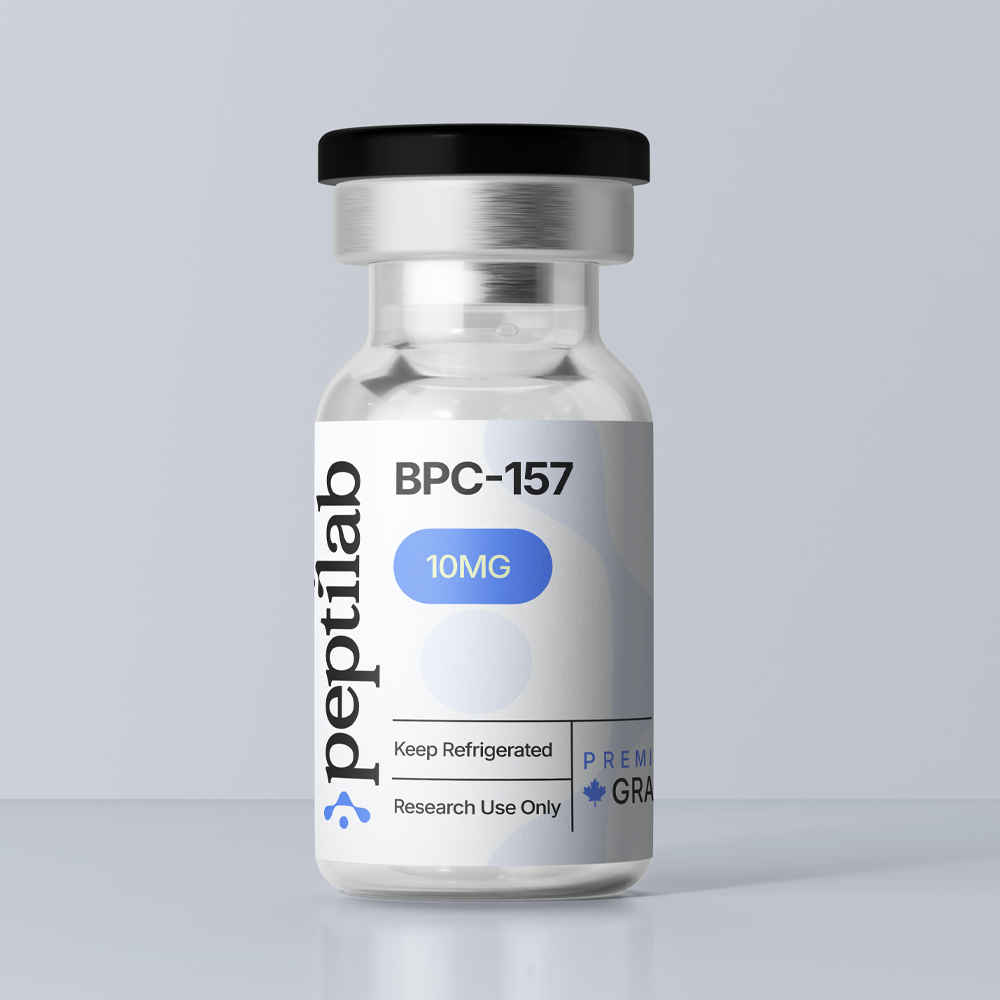
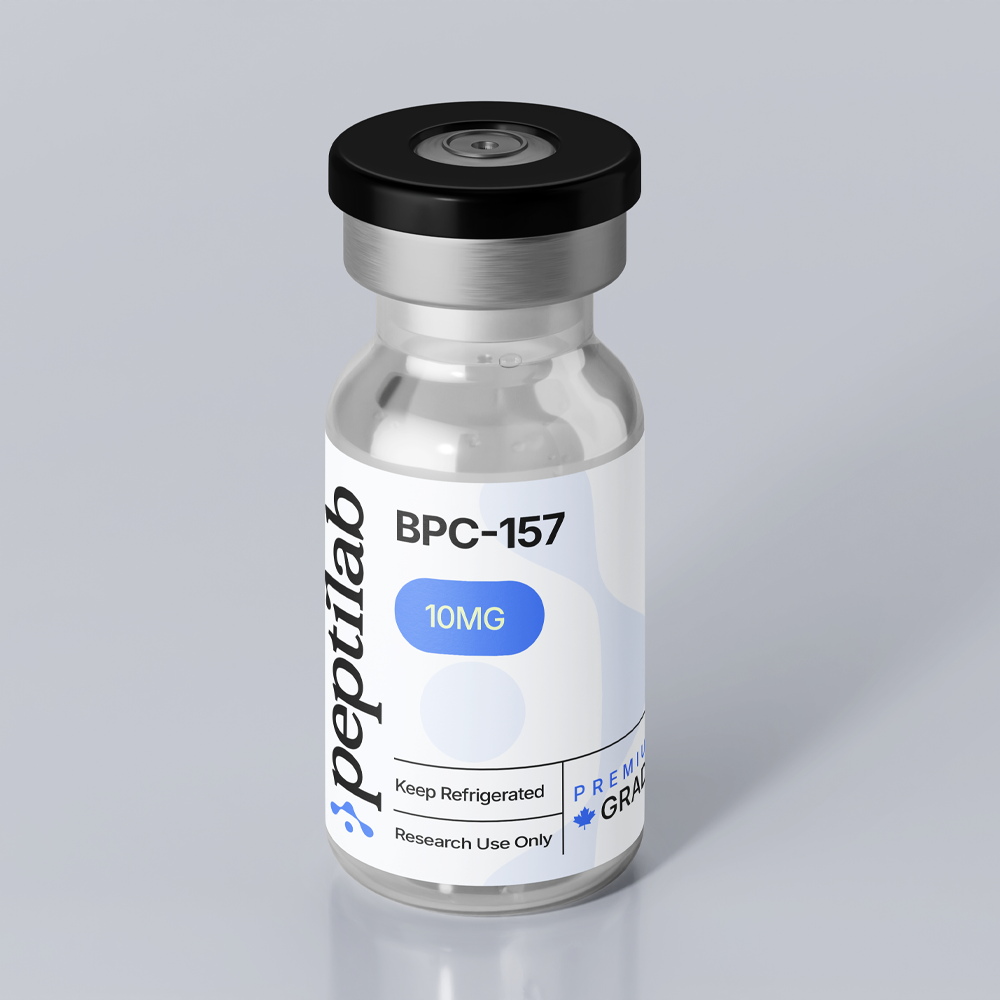
BPC-157 (10 mg)
$65.00
- Third-party tested
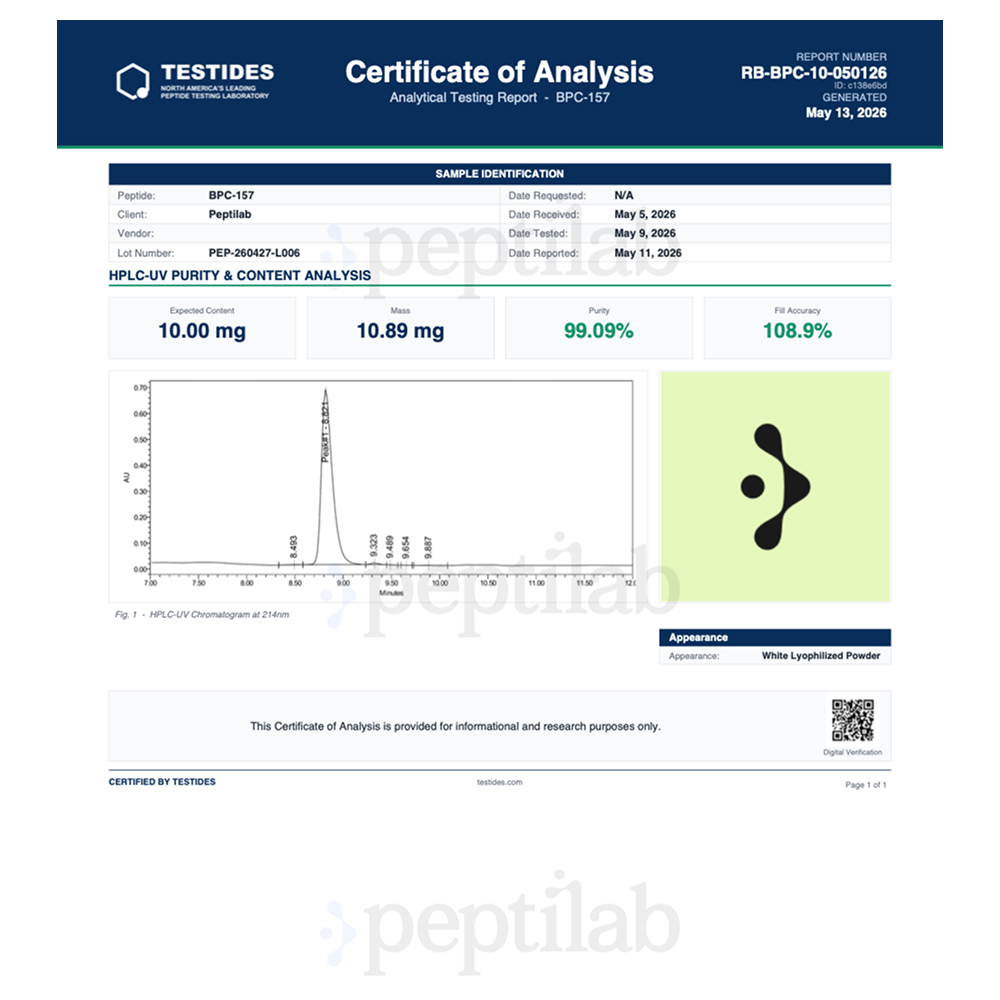
- COA included
- Ships from Canada
- Secure checkout
| Quantity | Discount | Discounted price |
| 3 – 4 | 5% | $61.75 |
| 5 – 9 | 10% | $58.50 |
| 10 – 100 | 20% | $52.00 |
BPC-157 is a synthetic pentadecapeptide derived from a protective protein sequence originally identified in gastric juice. It is one of the most extensively studied research peptides in regenerative biology, attracting significant scientific interest for its involvement in cellular signaling, tissue remodeling, angiogenesis, and connective tissue research.
Researchers continue to investigate how BPC-157 influences intracellular communication, extracellular matrix organization, angiogenic signaling, and cellular homeostasis under controlled laboratory conditions. As scientific understanding continues to evolve, BPC-157 remains an important compound for exploring the molecular mechanisms involved in tissue organization and regenerative biology.
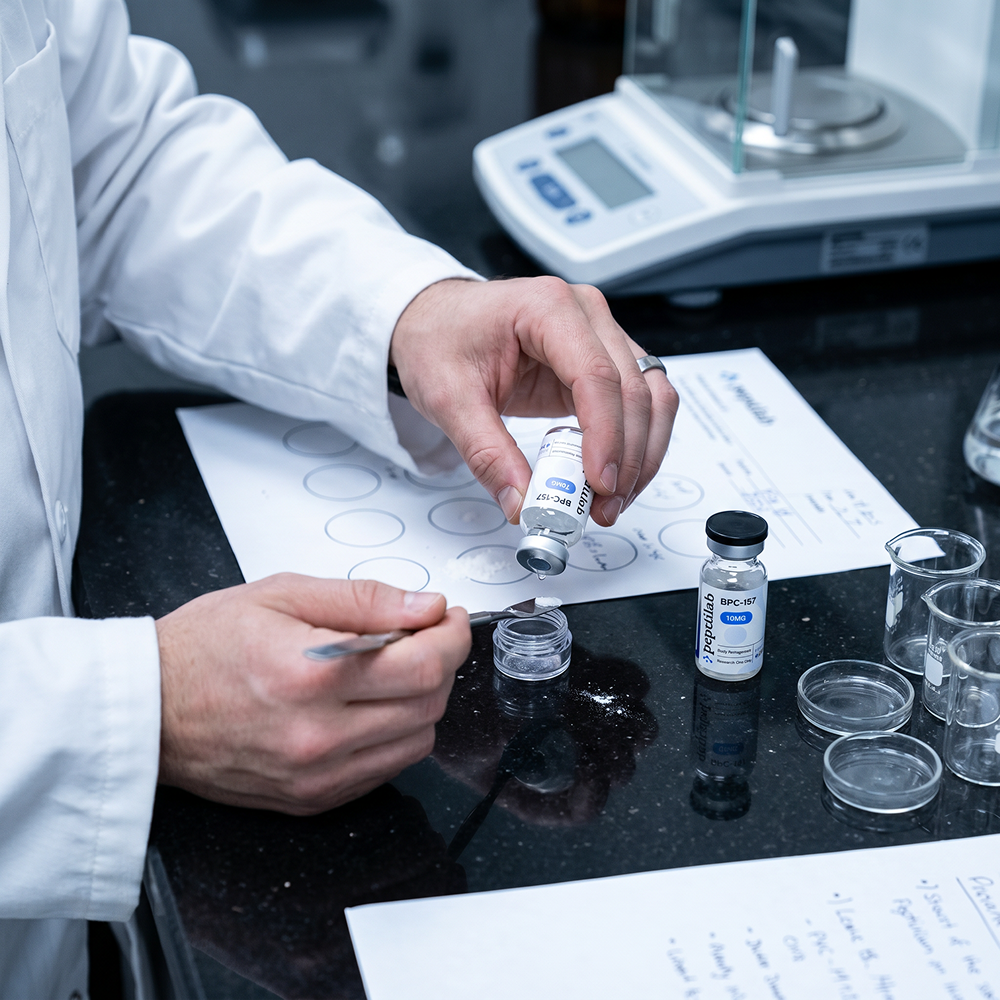
Supplied as a sterile lyophilized powder, BPC-157 is intended exclusively for laboratory and in vitro research applications. Every production batch undergoes independent third-party analytical testing to verify purity, identity, and consistency, supporting reliable and reproducible scientific investigations.
Product Specifications
| Specification | Details |
| Product Name | BPC-157 (Body Protection Compound 157) |
| Peptide Content | 10 mg per vial |
| Peptide Type | Synthetic Pentadecapeptide |
| Purity | ≥99% |
| Form | Sterile Lyophilized Powder |
| Application | Laboratory Research Only |
| Recommended Storage | −20°C |
Research Profile
BPC-157 is widely studied for its interaction with several biological pathways involved in cellular communication and tissue biology. Unlike peptides that primarily target a single mechanism, BPC-157 is investigated across multiple molecular systems, making it a versatile research compound for regenerative and cellular biology.
Laboratory investigations have explored its potential involvement in:
- Growth factor-related signaling pathways
- Nitric oxide signaling
- Angiogenesis
- Cellular migration
- Connective tissue biology
- Extracellular matrix regulation
- Collagen organization
- Endothelial cell function
- Cellular communication
- Protein expression pathways
Researchers continue to examine these molecular interactions to better understand peptide-mediated regulation of cellular processes and tissue organization.
Tissue Regeneration & Connective Tissue Research
One of the primary research applications of BPC-157 involves laboratory studies focused on connective tissue biology and regenerative cellular mechanisms.
Current investigations examine:
- Tendon cellular biology
- Ligament research
- Skeletal muscle studies
- Connective tissue organization
- Fibroblast activity
- Collagen remodeling
- Tissue engineering
- Regenerative biology models
These controlled laboratory studies contribute to a broader understanding of peptide-mediated cellular maintenance and tissue remodeling.
Angiogenesis & Vascular Biology
BPC-157 is frequently investigated for its interaction with biological pathways involved in vascular development and endothelial cell signaling.
Research commonly explores:
- Angiogenic signaling pathways
- Endothelial cell biology
- Vascular tissue regulation
- Nitric oxide systems
- Cellular communication
- Extracellular matrix organization
- Growth factor signaling
- Molecular regulation of vascular biology
These investigations help researchers better understand the complex molecular interactions that regulate vascular tissue function.
Molecular & Cellular Research
Beyond tissue-specific studies, BPC-157 is widely utilized in laboratory research examining intracellular signaling and peptide-mediated cellular regulation.
Research areas include:
- Gene-expression pathways
- Signal transduction
- Cellular differentiation
- Protein synthesis regulation
- Oxidative stress responses
- Cellular homeostasis
- Peptide-receptor interactions
- Molecular signaling mechanisms
Ongoing studies continue to expand scientific knowledge of the molecular pathways involved in tissue organization and cellular communication.
Product Care
To help maintain product quality and stability:
- Store unopened vials at −20°C whenever possible.
- Protect from excessive heat, moisture, and direct sunlight.
- Refrigerate immediately after reconstitution.
- Avoid repeated freeze-thaw cycles.
- Handle using appropriate sterile laboratory techniques.
- Follow established laboratory storage protocols throughout research use.
Product Note
All products are supplied as sterile lyophilized (freeze-dried) powder and require reconstitution before laboratory use.
Each production batch undergoes independent third-party analytical testing to verify purity, identity, and quality, supporting reliable and reproducible laboratory investigations.
This product is intended strictly for scientific research purposes. It is not intended for human consumption, veterinary use, diagnostic procedures, or therapeutic applications.
Frequently Asked Questions
What is BPC-157?
BPC-157 (Body Protection Compound 157) is a synthetic pentadecapeptide researched for its role in cellular signaling, connective tissue biology, angiogenesis, nitric oxide pathways, and regenerative biological processes.
What is BPC-157 studied for?
Researchers investigate BPC-157 in laboratory models involving tissue regeneration, connective tissue biology, angiogenesis, endothelial cell signaling, growth factor-related pathways, nitric oxide systems, extracellular matrix regulation, and cellular communication.
What form is the product supplied in?
BPC-157 is supplied as a sterile lyophilized powder, providing enhanced stability during storage and transportation before reconstitution.
How should BPC-157 be stored?
Store unopened vials at −20°C whenever possible. After reconstitution, refrigerate the solution and minimize repeated freeze-thaw cycles to help preserve product integrity.
Is BPC-157 intended for human use?
No. BPC-157 is supplied exclusively for laboratory research and is not approved for human consumption, medical treatment, or veterinary use.
| CAS Number | 137525-51-0 |
|---|---|
| Synonyms | Body Protection Compound 157, PL 14736, Bepecin, BPC |
| Molecular Formula | C₆₂H₉₈N₁₆O₂₂ |
| Content | 10 mg lyophilized peptide per vial |
All orders ship from Ontario, Canada. We ship within Canada only.
Same-day shipping on orders placed Monday to Friday before 2:00 PM EST. Orders placed after 2:00 PM or on weekends ship the next business day.
Tracking provided on every order — you’ll receive your tracking number by email as soon as your order is dispatched.
Standard Shipping: 2–5 business days. Delivered via Canada Post Xpresspost.
Express Shipping: 1–2 business days. Available at checkout for an additional fee.
Discreet packaging on every order. Plain outer packaging with no product names, branding, or content descriptions visible on the outside.
Cold chain: All peptides ship as lyophilized (freeze-dried) powder and are stable at room temperature during transit. Every order is packaged to protect product integrity upon arrival.
Free standard shipping on orders over $300.

You may also like
-
Crown Density — GHK-Cu Peptide Enriched Conditioner (1% / 2,360mg) | PeptiLab Canada
$32.00 -
KLOW — Quad-Peptide Research Blend (80mg) | PeptiLab Canada
$169.00 -
KPV — Anti-Inflammatory Tripeptide (10mg) | PeptiLab Canada
$75.00 -
Peptide Syringes (1cc/mL)
Price range: $5.00 through $8.50 -
Alcohol Wipes: Isopropyl Alcohol 70% v/v
Price range: $3.00 through $6.00


Actually was the wolverine 20mgs and 10 days in and most of my pain is gone!!
Quick service thank you!
Love it ????
Love this stuff! Top notch product.
FAST SHPPING. Received next day!!